
If you spent any time watching Summer Game Fest and Future Games Show this June, you probably came away with a list of games you’re suddenly very aware of. That’s the point of showcase season — controlled hype, carefully sequenced. But if you watched with the industry side of your brain switched on, something else was visible underneath the announcements.
The what — the titles, the trailers, the release windows — was never the interesting part. The interesting part was the how. How studios are positioning their games. What they’re leading with in a 90-second trailer. Whether they’re talking about platforms plural or platform singular. Whether post-launch support gets mentioned before the release date does.
The video game trends 2026 worth paying attention to aren’t the ones that got the loudest reactions in the live chat. They’re the ones showing up consistently across dozens of different studios, budgets, and genres — the patterns that suggest this is where the whole industry is heading, not just the studios lucky enough to be ahead of the curve.
Here’s what those patterns actually are.
AI’s Impact Expanding: Becoming Infrastructure
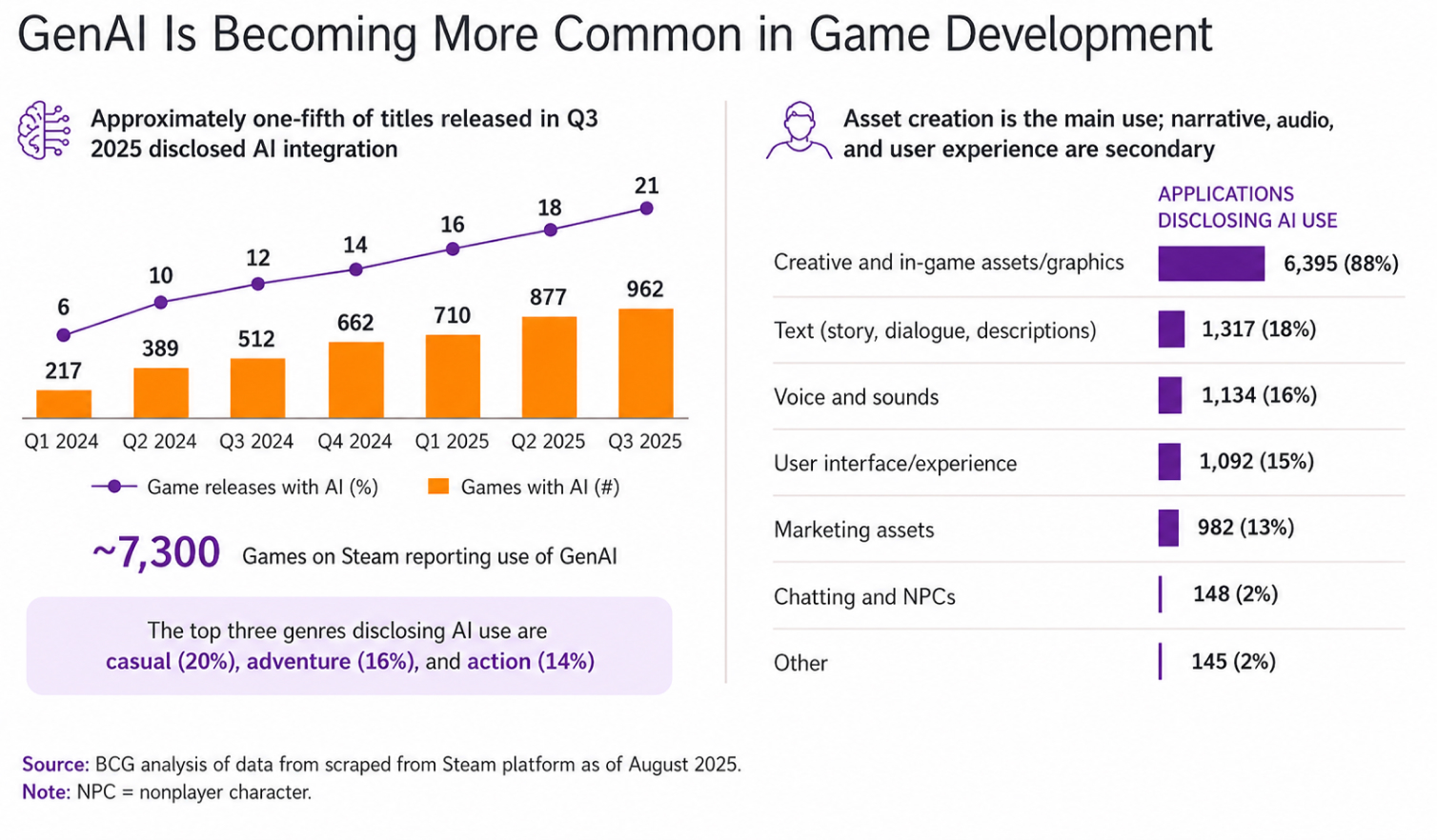
The question in 2023 was whether AI in game development would replace artists and designers. By 2026, most studios have moved on from that debate. The answer turned out to be: neither replacement nor magic fix, but a legitimate production tool that, used well, makes teams faster without making them smaller.
The more interesting shift is where AI is being deployed. Pre-production is the clearest win. Teams are iterating through concept art, quest structures, environmental layouts, and mechanic variations faster than was previously practical before committing resources to full implementation. Generative AI for game development has found its strongest foothold not in shipping final assets but in compressing the exploration phase — letting designers test ten ideas before picking one, rather than building the first idea that seemed good enough.
Step by step, artificial intelligence in gaming is changing live operations: automated QA, localization pipelines, and player support workflows are being augmented in ways that don’t make headlines but do reduce operating costs at scale.
The production story behind Exodus, the sci-fi RPG from Archetype Entertainment showcased at Future Games Show, is a useful illustration. The studio draws talent from BioWare, Naughty Dog, 343 Industries, and Electronic Arts — a pedigree that typically implies a large, established infrastructure. But Archetype is still a relatively young studio, and the 19-minute gameplay reveal at Future Games Show demonstrated a level of environmental density and narrative branching that would have been extremely difficult to prototype at that pace without AI-assisted content pipelines. That kind of output from a team of that age is increasingly the norm when AI is embedded in pre-production from day one.
Cross-Platform Is No Longer a Bonus Feature
The gaming platform convergence story has been building for years, but 2026 is the year it stopped being optional. Player expectations have outpaced platform strategy. Shared progression, cloud saves, cross-platform matchmaking, and unified friend systems are no longer premium differentiators — they’re baseline expectations for anything targeting a broad audience.
This has real production consequences. Cross-platform game development used to be a post-launch consideration or a mid-cycle port decision. Now it’s a day-zero architecture requirement for most multiplayer titles. Build for one platform, plan to fight for every other.
Summer Game Fest solidified cross-platform gaming as a concrete reality. Alien: Isolation 2 was confirmed for PS5, Xbox Series X/S, PC via Steam, and Nintendo Switch 2 — a full multi-platform release at launch. That’s a survival horror game, a genre that historically skewed toward single-platform development. The fact that Creative Assembly is targeting all four major platforms simultaneously signals something about the current production baseline, not just the marketing ambition. Guild Wars 3 offers an even cleaner technical case: ArenaNet built the game on Unreal Engine 5 specifically because GW2’s proprietary engine was single-platform by design, and porting it to PS5 would have required a near-complete rebuild. UE5 solves that problem structurally — the same codebase scales to PS5 hardware without a separate development pipeline. The engine choice was the cross-platform strategy.
User-Generated Content Has Become a Business Model
Roblox and Minecraft proved the concept. Fortnite Creative industrialized it. What’s happening in 2026 is the wider industry catching up — and recognizing that user-generated content in games isn’t just a community feature, it’s a content production strategy.
The math is fairly simple: a robust creator ecosystem generates content your internal team doesn’t have to build, drives session length your writers didn’t have to script, and builds community investment your marketing budget can’t fully replicate. When creators can also earn through the system — through revenue sharing, creator marketplaces, or asset sales — the incentive structure starts running itself.
Fortnite’s trajectory is the clearest data point here. In September 2025, Epic opened Fortnite’s creator economy to in-island transactions — letting developers sell durable items, consumables, and gameplay-affecting content directly within their UEFN-built islands. Full publishing capability went live in January 2026. That’s not a community feature anymore. That’s a platform. Mod ecosystem players like CurseForge and Mod.io are also seeing substantial growth, with mod downloads up 38% and 56% respectively, and creator payouts at Overwolf reaching $300M annually — now approaching Fortnite-level numbers. Palworld, announced at Summer Game Fest to be hitting 1.0 in July, is a game that has sustained its community partly through an active modding ecosystem during its entire Early Access period — and that base of player-generated content is part of what kept 32 million players engaged across two and a half years before the full launch.
Live-Service Has Stopped Trying to Be Everything
A few years ago, every publisher wanted a live-service game. Most of them ended up with an expensive lesson in what live-service actually requires to work.
By 2026, live-service games have matured into something more honest about the tradeoffs. The pivot isn’t away from live operations — it’s away from the assumption that constant content drops automatically equal retention. The studios still standing in this space have figured out that players don’t need more; they need meaning. Seasonal content, community events, and social systems work when they’re part of a coherent experience. They don’t work when they’re plugging engagement gaps in a game that isn’t compelling to begin with.
Live ops in gaming today is less about the volume of updates and more about the architecture of the player relationship. The titles announced at the 2026 showcases that led with live-service positioning weren’t selling content calendars — they were selling communities. That’s a meaningful shift in player engagement strategies, and it shows in how post-launch roadmaps are being communicated to players before a game even launches.
Palworld’s 1.0 announcement at Summer Game Fest is a useful example of what mature live-service thinking actually looks like in practice. Pocketpair spent over two years in Early Access building the game out iteratively, accumulating 32 million players, and the 1.0 launch isn’t a restart — it’s a culmination of a sustained relationship with an existing community. The World Tree, the expanded map, the new breeding systems: Pocketpair calls it the biggest update in the game’s history, but the framing around it is about delivering on a promise, not manufacturing urgency. That’s the difference between a studio that built a live-service community and one that just built a live-service product.
Monetization Is Getting Smarter — or at Least Less Aggressive
The gaming monetization models conversation has shifted too, though more quietly. Premium still works for AAA. But the middle of the market has been running experiments for years now, and some conclusions are starting to stick.
Battle pass systems are the clearest example. Early implementations leaned hard on FOMO — the fear that not buying this season’s pass meant falling behind permanently, visually or otherwise. Players noticed, and studios that didn’t course-correct felt it in the numbers. The modern battle pass design philosophy is almost the inverse: flexible progression, player-chosen unlock paths, and value that doesn’t expire the second the season ends. It’s a more sustainable approach to monetization, and it maps directly to long-term retention rather than short-term conversion spikes.
The most striking statement on this came from ArenaNet. Guild Wars 3 studio head Colin Johanson confirmed in an interview that the game will have no subscription fee and no battle pass, saying explicitly: “We will respect our players’ time.” In a genre where both mechanics have become default infrastructure, that’s a deliberate positioning statement. Johanson explicitly rejected both recurring fees and the seasonal battle-pass grind, framing it as not wanting to “hold players’ time hostage.” It’s worth noting that the Guild Wars franchise built its entire identity on this principle since 2005 — but restating it publicly in 2026, in a live-service landscape that has drifted sharply toward subscriptions and seasonal passes, carries more weight than it once did. It’s a bet that players are ready to reward restraint.
Mobile Isn’t a Separate Market Anymore
Mobile gaming growth has outpaced console and PC for years, but the more interesting trend in 2026 is the directional influence mobile design is having on the broader industry. Live-service frameworks, retention loops, session-length design, cross-platform progression — much of the infrastructure that PC and console studios are now building out was pioneered in mobile development.
The showcases reinforced this indirectly. Titles like the Cuphead sequel and Sonic Racing CrossWorlds were explicitly highlighted as targeting Nintendo Switch 2 — a platform whose portability makes it a natural bridge between mobile and console design sensibilities. Pick-up-and-play session design, short-burst engagement, and accessibility-first mechanics aren’t compromises on Switch 2; they’re features. That’s mobile thinking applied to a console context, and it’s becoming increasingly unremarkable.
For studios still treating mobile as a separate vertical, that framing is becoming a liability. The technical standards, player behavior patterns, and monetization learnings that come out of mobile are increasingly applicable across the stack. Studios that operate across platforms — rather than cordoning off mobile as a different discipline — are developing a more complete picture of player behavior than those that don’t.
Indie Games Are Still Where the Industry’s Brain Is
The blockbusters were at Summer Game Fest. But some of the most genuinely interesting games of 2026 showed up at Future Games Show — titles like Threads of Time, Vivarium, Apple Crumble, Chronoscript, and The Lift, which were experimenting with form, mechanics, and narrative in ways the AAA slate mostly wasn’t.
This is a consistent pattern, not a surprise. Indie developers operate without the organizational drag that slows large publishers, which means they can take structural risks that would require a committee at a major studio. Lower development costs, accessible engines, AI in game development tooling, and digital distribution have continued to lower the barrier for small teams to ship something genuinely original.
AAA borrows from indie. That pipeline — where Celeste and Hades and Disco Elysium shift what the industry thinks is possible, and the larger studios eventually catch up — is still running. Paying attention to the indie tier isn’t just aesthetically interesting; it’s a reasonably good predictor of where the broader game development trends are heading in 18–24 months.
What the Showcases Actually Confirmed About the Future
Reading across Summer Game Fest and Future Games Show together, a few things stand out clearly.
Established IP still commands attention. Resident Evil Veronica, Alien: Isolation 2, Guild Wars 3, Virtua Fighter Crossroads, and Final Fantasy VII Revelation generated the loudest reactions — which confirms that franchise recognition is still one of the most durable assets in the business, particularly in a climate where players are more selective about what they adopt as a long-term gaming commitment.
Simultaneously, the mid-market is healthier than the discourse around it suggests. Future Games Show alone featured over 40 titles spanning a wide range of budgets, aesthetics, and ambitions. The “mid-tier is dead” narrative doesn’t hold up against the actual release slate.
And the architecture thinking is shifting at the design level. Even traditionally single-player experiences are being built with community hooks, optional social layers, and post-launch content strategies baked in from the start. Ecosystem design has become as important as game design — the question isn’t just what you’re shipping, but what you’re building around it.
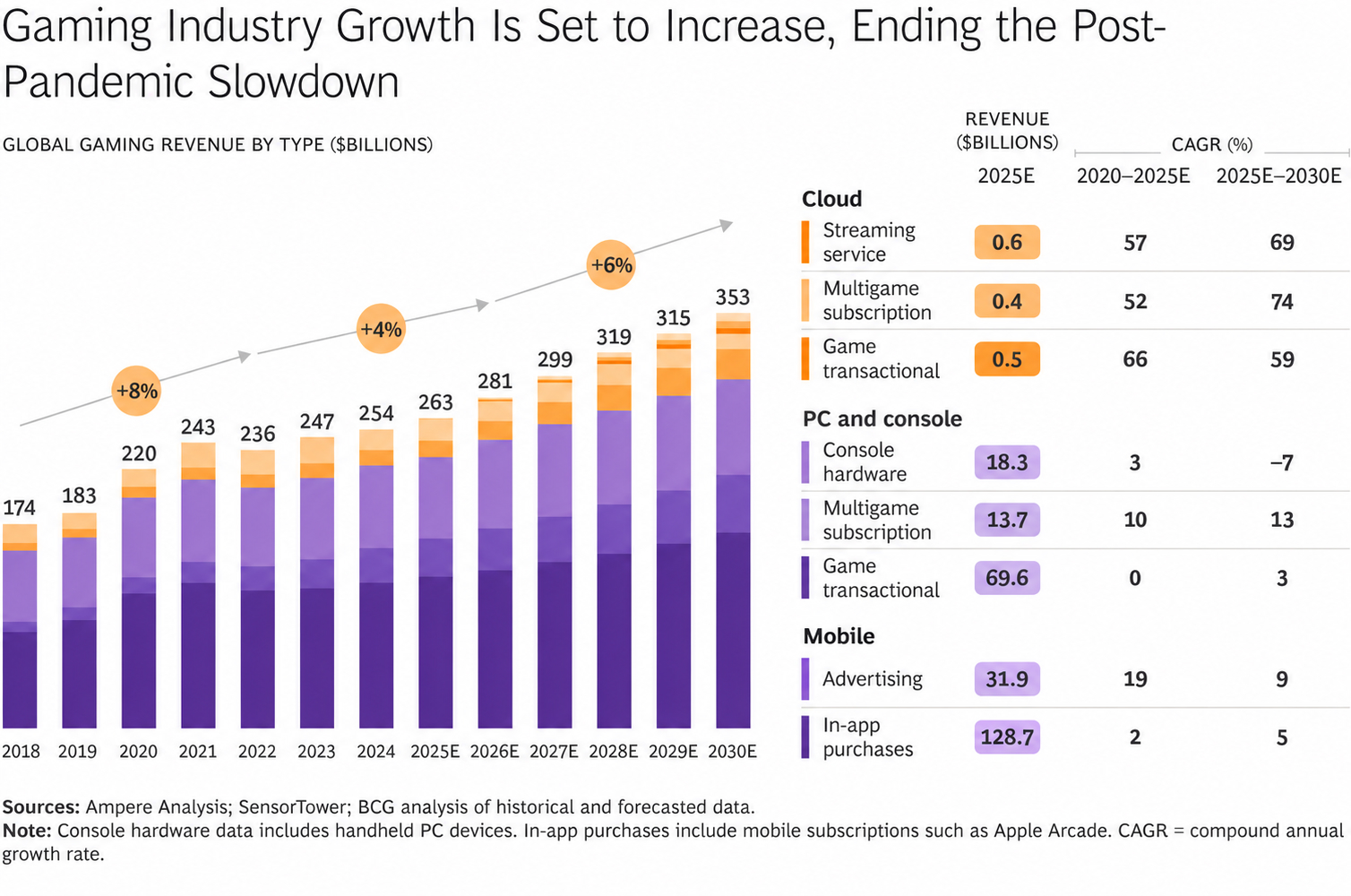
The Bigger Picture: Video Game Industry Forecast Through 2027
Here’s the thing about every trend listed above: none of them exists in isolation, and that’s exactly the point.
AI speeds up production. Cross-platform opens the audience. Creator economies extend the content pipeline. Live-service builds the retention layer. Mobile design principles inform the whole stack. These aren’t parallel trends running on separate tracks — they’re converging into a single underlying shift in what a “game” actually is as a product.
For most of the industry’s history, a game was a thing you shipped. You built it, you launched it, you moved on. The trends of 2026 are collectively dismantling that model. What’s replacing it is closer to a platform — something that’s designed from day one to grow, adapt, and sustain a community over years rather than weeks. The studios winning right now aren’t just making better games. They’re building better ecosystems around them.
That distinction sounds abstract until you look at where development resources are actually going. Pre-production is expanding because AI makes iteration cheap enough to explore more before committing. Cross-platform architecture is moving earlier in the pipeline because retrofitting it costs more than building it in. Live-service thinking is influencing genres that have never needed it before, not because publishers are chasing trends, but because player behavior — shaped by a decade of mobile and live games — now expects it.
The video game industry forecast heading into 2027 isn’t really about which specific technologies win. It’s about which studios have internalized this shift at the organizational level — not as a strategy layer bolted onto production, but as the actual way they think about what they’re building and for whom.
That’s a harder problem than it sounds. And it’s the one worth solving.
At Stepico, we work with studios building for that longer arc — full-cycle development, AI-assisted production pipelines, cross-platform engineering, and AAA art production. If your next project needs a partner who thinks in ecosystems, not just deliverables — let’s talk.