
This interview was originally published in Ukrainian on GameDev DOU on July 15, 2026. Interview by Ruslan Kumekov. Translated and republished with permission.
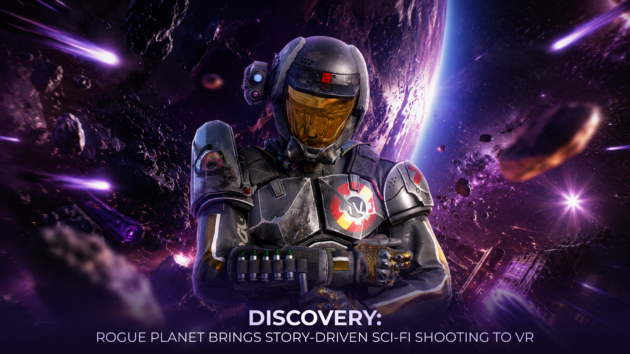
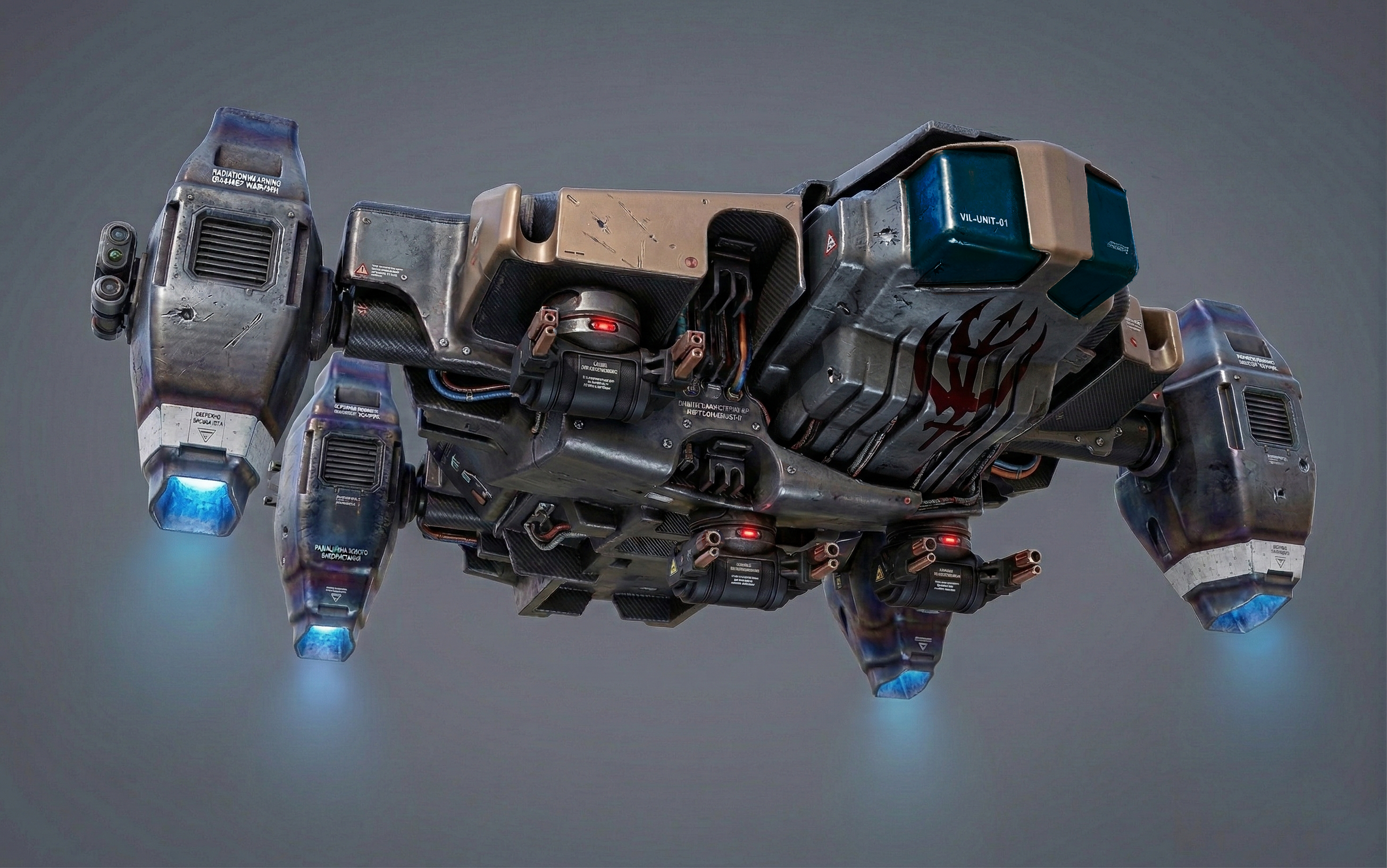
Ukrainian studio Stepico built a successful outsourcing business over many years — but the ambition to ship a game of its own never went away. To make it happen, the team spun up a dedicated brand, Immersmind, and developed its debut title: Discovery: Rogue Planet, a story-driven VR adventure shooter published by Meta itself. Players are in for a journey across the desert planet Rogax aboard a giant, 30-meter machine.
We sat down with the project’s creative director, Roman Yermakov, to talk about the shift from services to product, what it takes to develop for standalone VR, and Meta’s requirements — as well as why the team had to cut certain physics mechanics, how testers hunted bugs crawling on their bellies, and how Hordiy Starukh’s folk-infused score shaped the atmosphere of this space western.
From a Demo to a Dedicated Studio with a Tight Budget
— At what point did your team realize it was ready to build its own product?
Honestly, we’d all dreamed of making our own game from day one. At some point, we started building out an Unreal team at Stepico. We had a group of enthusiasts, and we put together a small fake demo for the portfolio — it looked like a game, but it wasn’t one. There was never any plan to release it; we just wanted to show what we could do in Unreal.
The demo went over really well, so I took an idea to management: let’s build a real demo and go find a publisher. They gave it the green light, and things took off from there.
— What else motivated you? Was it something the team wanted?
At first, it was our art director and me. The two of us kicked off the project, fell completely in love with it, and wouldn’t let it go. Management heard us out and said: “Alright guys, this looks promising — run with it.” So we did.
In the beginning, we still weren’t making a game — we were making pitch materials. That fake demo was portfolio-only. Then we started shaping our vision of the actual game, preparing materials for it, going deeper into Unreal, and we built another demo on our own. That one was mostly visual too; the only real gameplay was walking around a bit.
But the important part is that we started working out our vision — what this game would actually be about. And I’ll say up front: the concept changed a lot along the way. The original plan was a third-person game, something in the spirit of Monster Hunter, but with modern firearms in a sci-fi setting.
— So VR wasn’t part of the idea from the start?
No, not right away. At first, we planned a full third-person game in Unreal. I’m not saying it was going to be a Monster Hunter clone, but gameplay-wise, that’s the direction we had in mind. The concept kept getting trimmed as we went. And once we moved to VR, we had to live with VR’s limitations, so it shifted again.
— Why did you spin the product side off into a separate studio, Immersmind?
There were two reasons. One was purely organizational; the other — call it reputational — was mine.
On the reputational side: this is our debut, and we didn’t want players’ first thought to be “oh, this was made by an outsourcing company that does a bit of everything.” A game lands better when it’s the debut title of a dedicated studio. Everyone agreed that made sense.
The second reason was organizational: outsourcing and product development run on completely different processes. Splitting them apart meant less confusion. The project started inside Stepico, but once we grew past two people, that setup stopped working. We’d get people assigned on a “whoever’s free right now” basis.
On one hand, it was an internal sci-fi project with great visuals, so artists loved it. Everyone wanted to contribute at least something, which makes sense: when your day job is routine client work and suddenly there’s a project you can call your own, that’s a draw.
On the other hand, it created chaos, because a revolving door of people is terrible for product development. I came to Stepico from the product side myself, and honestly, the outsourcing rhythm was hard for me to adjust to — people constantly rotating in and out, everyone jumping between projects. So in the end, we decided we needed a dedicated team nobody would touch.
Plus the image factor I mentioned. We’re not hiding that we’re part of Stepico — it’s simply a separate direction with its own branding.
— How hard was it to rebuild your processes after years of service work?
Before we split off, it was a nightmare to manage. People kept coming and going: someone joins for a month, someone else for two weeks. And you’re trying to carve up the work so each person can actually finish something in that window without leaving a mess behind. It was very hard to keep under control.
Once the vision and the team were fully in place, everything got easier. I have a product background, and nearly two-thirds of the team did too, so from that point on there were no real problems.
— Do you have a stable team now? How many people are on the project?
Yes — a stable team formed almost immediately after we split off. Given that we’re a small studio, to put it mildly, and the project isn’t huge, we peaked at around twenty people.
We still use outsourcing and contractors. Sound, for example, was done externally — it wasn’t an in-house role (the game’s soundtrack and sound were created by Ukrainian musician and sound producer Hordiy Starukh — ed.). We also brought in a few artists for a specific scope of work. They weren’t part of the core team: we defined exactly which assets we needed, handed the work over, our art director reviewed the results — done.
So yes, we used outsourcing in our own development, but sparingly. Engineering — never. But early on, a lot of the art, sound, and QA — absolutely. Through Stepico, naturally.
— Did your experience in service-based development help while working on Discovery?
Absolutely. Experience is experience, and outsourcing teaches you a lot.
One of its biggest advantages is that it trains you to work efficiently within a budget. When you have a client and an agreed budget, you have a certain amount of freedom in how you approach the work. But if you go over budget, the company covers the extra costs, not the client.
That is why outsourcing teaches you to control spending, calculate costs carefully, and plan production properly. Budgets are also closely monitored in product development, especially at large studios, but there is usually more room for error. In that sense, my outsourcing background helped a lot.
It also gave me a strong professional network. Several people I met through outsourcing contributed to the project and supported us along the way.
At Stepico, I worked as an art director, so I was involved in a very wide range of art-related tasks across completely different projects. Before that, I spent eight years at Wargaming working primarily on a single title.
The variety of experience I gained at Stepico has definitely been valuable. It helps rather than creates confusion.
A Niche Market Without Big Budgets, Stylized Art, and Meta’s Requirements
— Why did you ultimately land on VR?
Honest answer is pretty unglamorous: we were looking for a publisher and a partner. We got in touch with Meta, and they offered us a partnership on good terms. VR was their condition, of course.
We talked it over with what was still a tiny team, played a bunch of VR games, and — I won’t pretend otherwise — it hooked us. It was a new experience, and we figured it was worth a shot.
We understood right away there would be limitations and cuts, that a lot would have to be squeezed into a headset. But that was also the challenge. We were curious, so we went for it.
— What technical trade-offs did VR force on you?
The first thing we had to do was scale back the art. We’d wanted a fairly realistic, detailed look, but that’s tough in VR — the headset is essentially a mobile phone strapped to your face, and it renders two images at once, so the optimization requirements are brutal.
So the art style was the first thing we reworked. We pushed it toward stylization. Chase realism in VR and it just looks bad; stylize it, and everything reads as intentional.
The second cut was the sheer amount of stuff: enemies, objects, everything. We’d wanted a dense, detailed world with little creatures and insects crawling around. Some of that survived, but there was no way to fit all of it into VR.
— And what did VR make easier?
Since it’s a VR shooter, we didn’t need a single animation for the player character. Everything is done with your hands.
Reloading is fully manual: you physically pull the magazine out of the gun, and no animation is needed for that. All you have to build are grip poses — the rest blends on its own. You eject the mag, toss it, grab a fresh one from your belt, slide it in. Some weapons got fairly realistic mechanics, like racking the slide. On the revolver, you can even cock the hammer to fire faster.
None of that needs animation. That’s a huge chunk of work VR saved us.
— What was the hardest part of building for VR specifically?
Movement. That’s probably what we reworked the most, because you have to accommodate the widest possible audience.
Full locomotion doesn’t work for everyone — it makes some people motion sick. So we built standard movement, a seated mode, and teleport for those who really can’t handle it, all in parallel.
Luckily, Valve had released a very detailed video on the making of Half-Life: Alyx, including a deep dive into their movement design. That made things easier — at least we knew where to look for answers. It was still a mountain of work, though.
We also had to get creative with physics. A lot of our physics is actually fake. If you toss something on the ground, it doesn’t follow real physics — real physics hammers the processor. Wherever we could get away with it, the object just falls along a preset curve and dissolves when it hits the ground. There were a lot of compromises like that.
— On the technical side, what did you learn from?
We’re hardly the first Ukrainian company to make a VR game. And if you set aside the VR-specific mechanics, it’s remarkably close to mobile development — the hardware is similar, unfortunately. PCVR would be closer to a regular PC game, with the differences mostly in controls. But standalone VR — which was Meta’s requirement — is a different beast.
— What’s the hardest part of standalone VR?
Optimization, hands down. You’re basically working with a mobile device, except the screen wraps 360 degrees around you. In a headset, every flaw is visible, so optimization is the hardest thing about VR.
Making the mechanics genuinely fun matters just as much, of course. There are plenty of cases where well-known games simply get ported to VR, and when it’s done well, they still play great. Flat2VR Studios are a good example — they keep shipping VR adaptations of games that already did well in their flat versions.
But if you’re building VR from scratch, you need designers who can create mechanics that work specifically for this format. And you need experience. We picked ours up on the job.
— How attractive is the VR market for Ukrainian studios right now?
It is a difficult market. A very difficult one, to be honest. Studios are laying people off, budgets are being cut, and companies are reducing spending across the board. VR is also a niche market: the number of VR players simply cannot be compared with the audiences on PC and consoles.
Another important factor is that Meta holds a much larger share of the VR market than SteamVR or PlayStation VR. As a result, the overall health of the VR games market depends heavily on Meta. When a single company has that much influence, one poor decision can affect the entire industry.
When we started development, VR seemed to be gaining real momentum. Meta was investing heavily in the space, and several major VR titles were either released or announced, including Batman: Arkham Shadow, Skydance’s BEHEMOTH, Alien: Rogue Incursion, and Metro Awakening.
At the time, it genuinely felt as though VR was growing quickly. Later, however, it became clear that the situation was not quite as promising as it had initially appeared.
— But the audience is there?
The players are there. VR has its downsides — the player base isn’t huge — but also its upsides: there aren’t many games either, so competition isn’t actually that fierce. The golden rule of VR is: don’t spend big. Big budgets just don’t earn out there. Keep the budget lean, and if the game more or less lands with players, that’s a win.
And we were lucky to have Meta as a partner. That doesn’t mean they handed us money and walked away — they gave us real support, a lot of it technical.
— Did you research the geography of the VR audience? Am I right that the core players are in the US and Europe?
Yes — we even commissioned a study by an analytics agency.
More precisely, we conducted our own research and then commissioned an additional study from an agency. We were prepared in terms of understanding the audience and the market.
What we were not prepared for was the release of Gorilla Tag and the sudden influx of players aged roughly ten to fifteen into VR. Honestly, that was impossible to predict.
Meta looked at the situation and effectively decided, “This is now our key audience.” They began shaping much of the platform around teenagers.
The problem was that this teenage audience did not need much beyond two particular games. Fortunately, Meta now seems to be returning to its previous strategy, with proper games for adult players and a more conventional approach to development.
That gives us reason to believe things will work out well.
— But VR is still a niche market.
It is. Let’s face it: the technology is still nowhere near where it needs to be. Plenty of headsets make people motion sick. They’re still bulky. Sure, there are premium models with mini-LED displays, top-tier lenses, eye tracking — but those cost far more than a Quest 3 and need a powerful PC to show what they can do.
Our research also showed that the total number of Meta headsets sold does not mean that every device is actively used for gaming. Many people buy headsets simply to watch YouTube or films.
Eventually, the technology will push the market forward. Headsets will become smaller and better, and VR will move beyond its niche status. That will happen sooner or later.
For now, however, it remains an additional device that costs about as much as a console. Not many people are willing to spend even $300 on the entry-level version.
On the one hand, it is a self-contained device. You buy it and can immediately play without needing anything else. You can also connect it to a sufficiently powerful PC and play PC VR games.
Even so, it remains a niche at the moment.
This is also happening against the backdrop of the broader crisis in the game industry — or in almost everything except artificial intelligence.
— Meta supported you throughout. Do they have formal standards for VR development, beyond requiring standalone?
Of course. They even have a name for it — the Meta Quest Virtual Reality Check (VRC) guidelines. It’s openly available to developers: a set of rules, requirements, and documentation. It runs to many pages and covers the technical side too.
It spells out how movement, performance, and everything else should work. Framerate is critical in VR — if it drops, people can get motion sick — so the specs come with hard numbers: framerate has to sit at 60–72. Lower is only acceptable on older devices like the original Quest, where the refresh rate was lower anyway.
It’s like that across the board. Even accessibility gets its own section — requirements for one-handed play, for instance. Those aren’t mandatory, but the more VRC boxes you tick, the better your game gets surfaced in the store.
When Meta partners with you, they also bring in their own QA team at the end, which delivers the verdict: release ready or not. They work straight from that documentation, catch bugs, and point right at the rule: this clause, this violation, fix it. Every issue even gets a severity level based on how much it could affect players. Everything is laid out very precisely.
Obviously, even without a partnership, Meta would still check the key standards during store review — just not in this much detail. As partners, we’re expected to comply with everything to the letter.
— Is that hard to pull off? Can you give an example?
It’s not so much hard as it is extra work — important extra work. For example, strange as it sounds, implementing pause was hard. There are a billion requirements for pause in VR.
First, pause has to be mapped to a specific button on the left controller. Fair enough. Second: when you press the button and the Meta Universal Menu opens, that also has to pause the game. But it can’t simply pause — the in-game hands have to disappear, because the system swaps in its own interface hands. If your game’s hands are still visible, that’s a bug, and it counts against you in review. They have to be disabled during pause.
Then there’s what happens when you take the headset off — our biggest headache. The headset drops into power-saving mode. This is supposedly handled by their Unreal plugin, but we still had to do serious work on it.
At one point, taking the headset off would trigger power-saving mode, rendering wouldn’t resume, and you couldn’t get back into the game. They bounced that back to us. We eventually fixed all of it. And that’s just one example — from pause alone.
The bigger point is that a VR game can be broken in far more ways than a regular one.
We had one funny bug. In the tutorial, we teach the player to unscrew bolts with our power drill: remove a grate, take out an overheated part, swap in a working one. Somehow it turned out that if you held onto the grate with your other hand while unscrewing, the last bolt wouldn’t come out.
In a flat game, that just can’t happen. But here you’re reaching in with real hands, gesturing however you like. If an object is grabbable, you can grab it any way you want. So all kinds of non-obvious issues kept surfacing — things we’d never even thought about.
Fortunately, we had a QA specialist who really threw himself into it. He literally crawled around on his belly checking where you could teleport to. He told us he’d climbed onto a cabinet to see if you could get over it. Meta’s testers generally know where to look too — they found a lot for us. But some bugs, nobody in the world would ever think of.
Nova Poshta Drones, a Cow Boss, and Why the Driver’s Seat Had to Go
— How did the Monster Hunter-like shooter concept grow into what Discovery is today?
Broadly speaking, the concept remained more or less intact.
From a narrative perspective, Discovery is still a shooter set on another planet, featuring monsters and other fantastical enemies.
Originally, however, we planned to include more mechanics related to tracking, slower tactical elements, scanning the environment, and similar systems.
We had to remove those ideas partly because of the budget and partly because VR requires shorter play sessions. VR imposes limitations not only through hardware, but also through the physical capabilities of players. Many people simply cannot play for long periods.
Longer levels would also have required many checkpoints, which would have been difficult to implement from a development perspective.
— In your materials, you’ve described Discovery as a road-movie game. How does that show up?
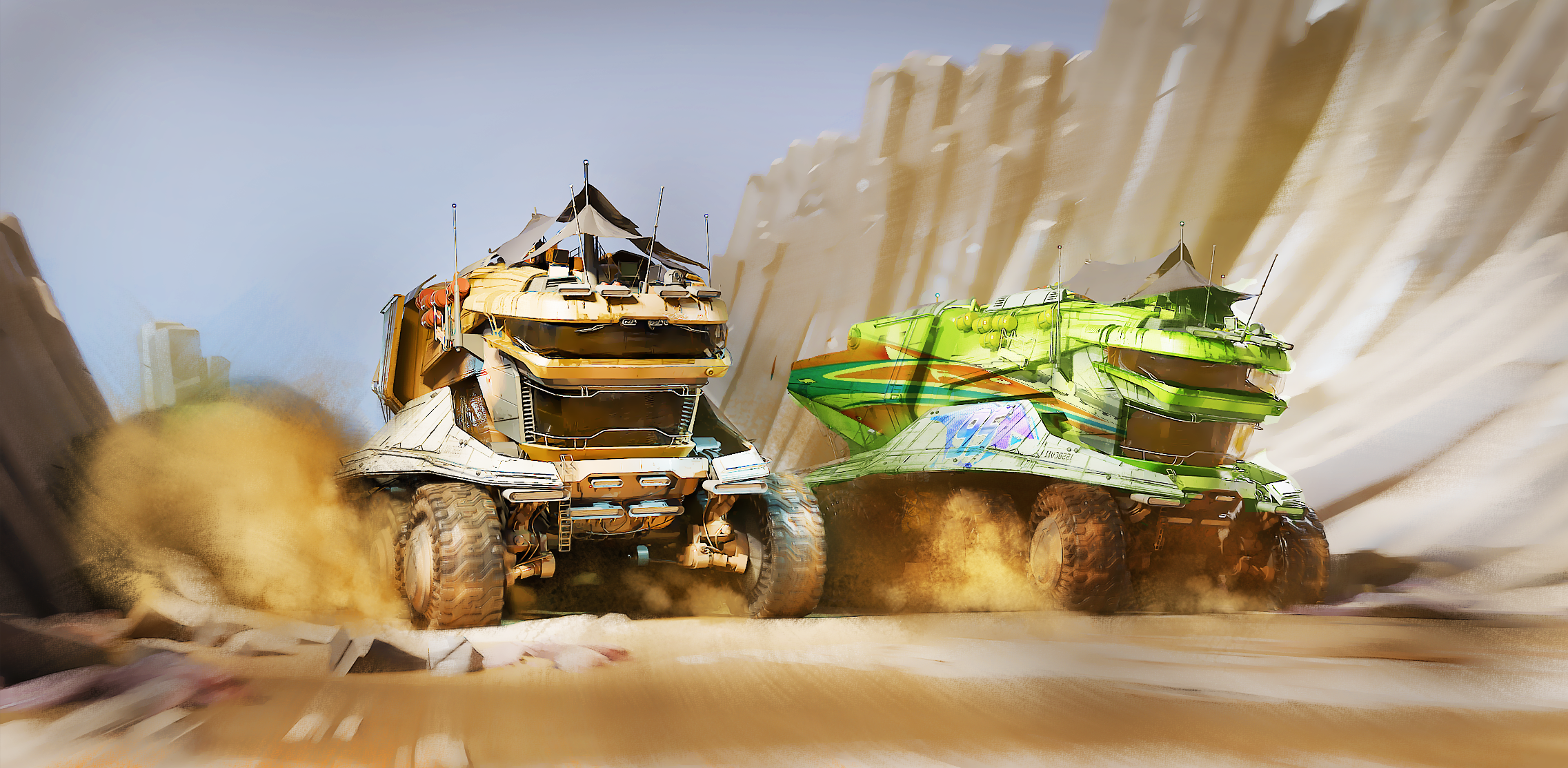
Discovery is the name of the enormous machine in which we travel. The structure of the game is essentially this: we move from point A to point B, and along the way we stop for different adventures, which become the game’s missions.
I cannot reveal too much about the story because I do not want to spoil it.
The machine was also part of the concept from the very beginning. Even in the earliest version, we intended for the player to travel aboard Discovery. That is where the title of the entire game came from. The vehicle existed before the concept for the main character.
First, there was a truck, and we called it Discovery. Then we developed the protagonist, followed by the planet and the setting, and everything grew from there.
— How would you describe Discovery in terms of genre and concept?
Everything is fairly straightforward. It is a classic story-driven adventure shooter. We do not have an extremely complicated concept. We simply tried to make the experience as enjoyable as possible in VR.
Since it’s a shooter, we probably spent the most time on the shooting itself. Shooting in VR is fun — it’s not a mouse. But that fun takes work. We went through countless iterations on the gunplay alone: hit impact, enemy reactions, all of it. It ate a lot of time, and everyone’s happy with the result.
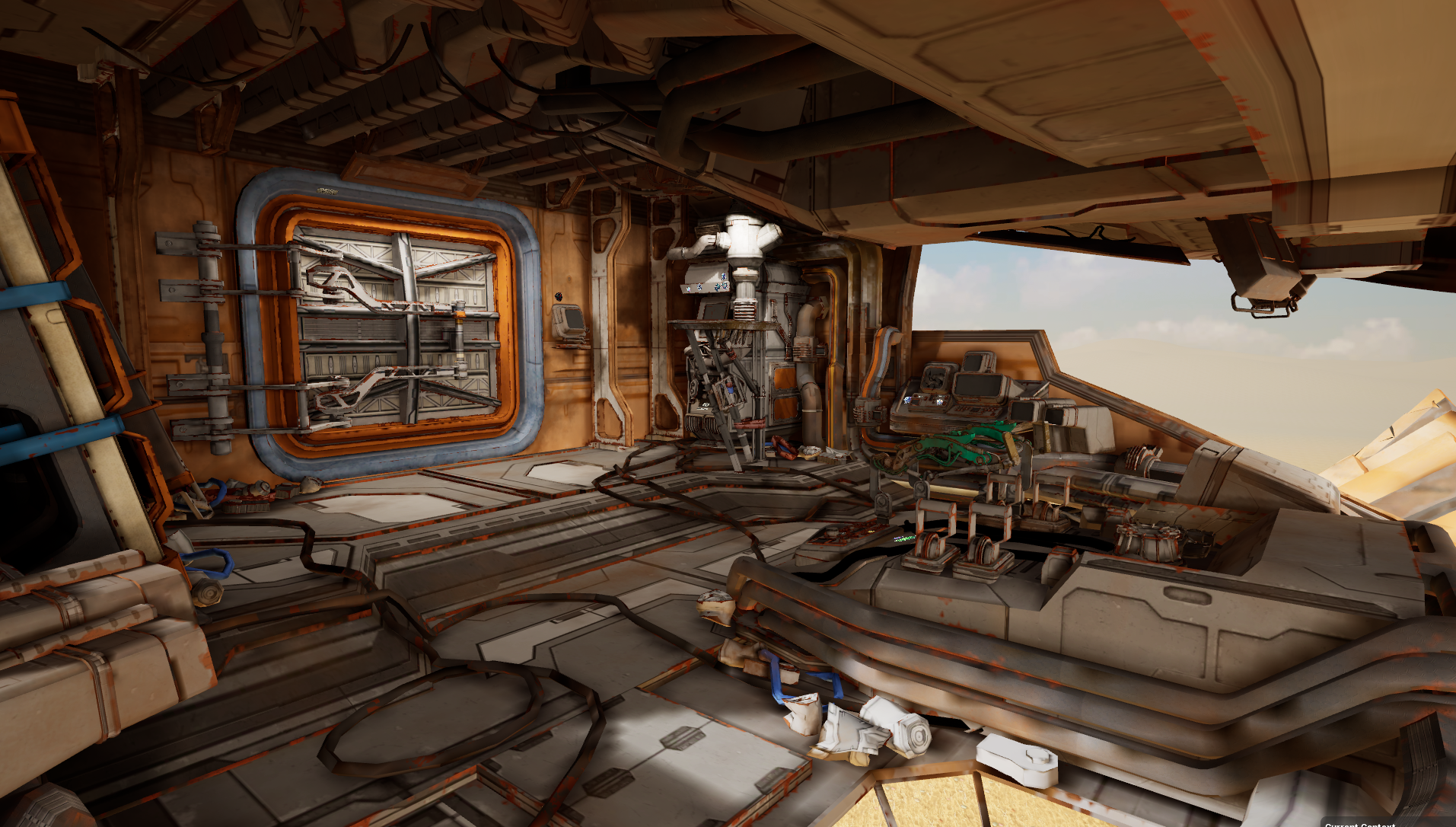
The second hardest thing was driving the Discovery. It’s no ordinary vehicle — there’s no steering wheel. The controls are tank-style, two levers, because the machine is heavy. It’s nearly thirty meters tall; a steering wheel would’ve been the wrong call.
That surfaced an unexpected problem, by the way. Originally there was a driver’s seat you’d sit in to pilot the machine. But chairs don’t really work in VR. Or rather, they do — until the player physically stands up and walks straight through the chair.
So we made the Discovery a stand-up drive, to avoid the situation where you just get up and step back through your own seat.
— Did you look at other sci-fi VR titles or VR games in general during development?
Of course. We played almost everything: not only sci-fi games, but also shooters and racing games.
There are not actually many VR racing games. Developers usually do not worry too much about the seating issue: there is a chair, and that is fine, because most people play racing games while physically seated. In that context, the concept works.
In our game, however, players spend most of their time moving around, and most people play while standing.
Creating a chair in which the player is virtually seated while physically standing would have felt illogical.
There are many issues related to perception. When you are sitting in the game but standing in reality, your brain can begin to struggle with the contradiction. VR can deceive perception very effectively.
Here is one example: a friend of mine bought PlayStation VR and launched the Star Wars game Tales from the Galaxy’s Edge. At the beginning, you enter a beautifully designed bar. The first thing she did was lean against the bar counter — and fall over.
I think many people who have tested VR have stories like that. It is also what makes VR so impressive. That is one of its strongest qualities: the sense of immersion is extraordinary.
— How did you create the planet Rogax? Does it date back to the pre-VR concept?
Yes, and that also has an interesting history. When we first began creating the planet, the idea was that it should resemble a dried-up ocean floor.
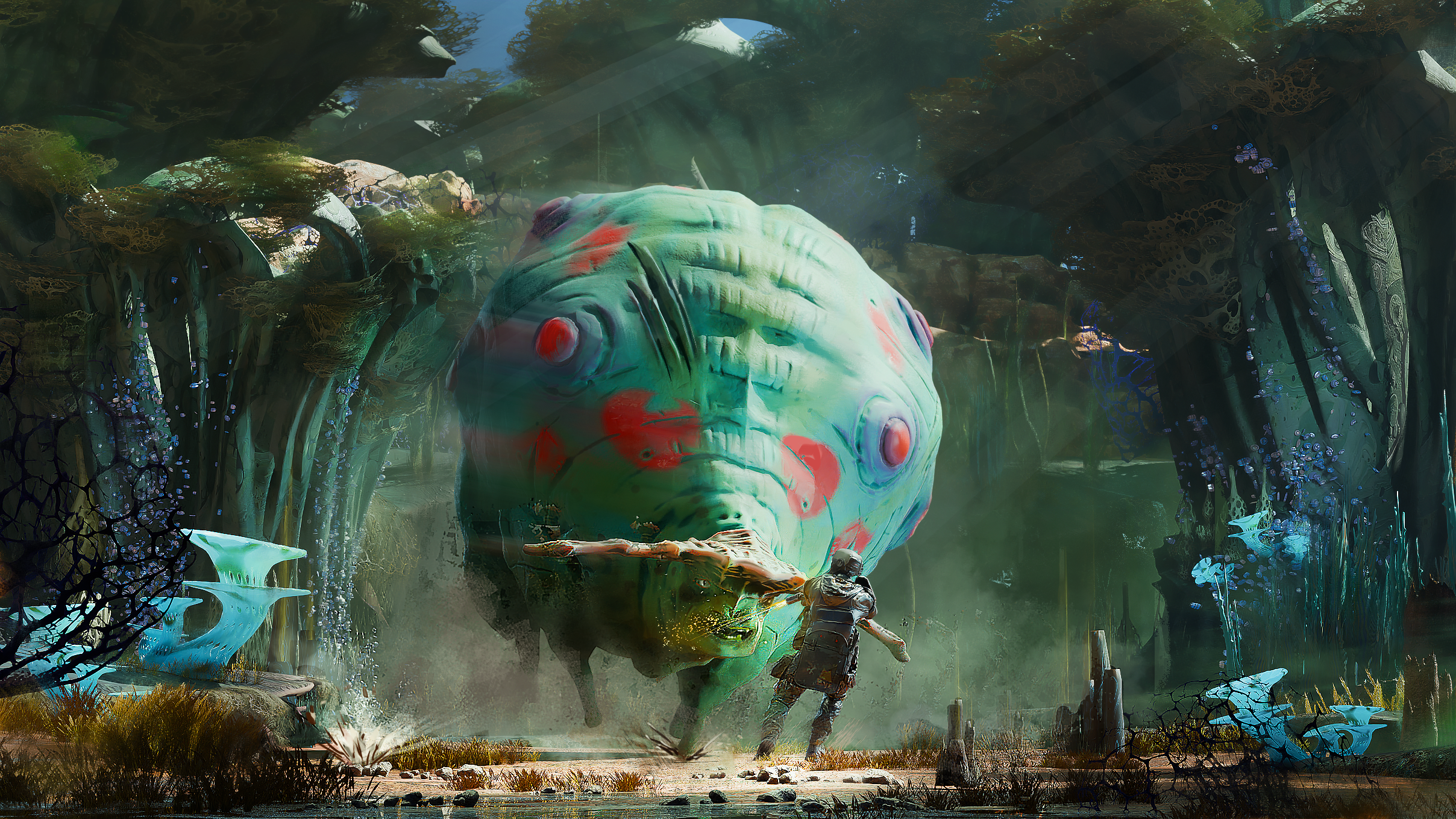
We developed the lore of Rogax around that concept. The planet was once completely covered by an ocean. Then a rogue planet passed extremely close to it and, through its gravitational influence, caused almost all the water to evaporate.
As a result, Rogax became a desert, while traces of vegetation survived in some of the deepest areas. The animals that lived there also adapted and mutated.
We tried to design the plants so that they resembled coral. Some of the animals are similar to crabs.
Naturally, the game is not remotely hard science fiction. We have no scientific basis for what would happen if an underwater animal adapted to life on the surface. We approached it more as a form of fantastical fiction.
— Were there lore details that didn’t make it into the game?
Yes. There’s one idea that flickers in the background but is never stated outright: the corals secrete a substance that gets processed into a drug. And since the planet is remote, it also attracts plenty of crime.
But we figured taking a rating hit for something that never touches gameplay wasn’t worth it. It lives in the lore, but it doesn’t really surface anywhere.
Early concepts had yellow pollen the drug was made from, along with a mechanic we wanted to bring into VR: damage your helmet, breathe in the pollen, suffer the consequences. A cracked helmet is genuinely cool in VR — but we cut it, partly for the rating, partly because scope had to shrink everywhere.
That’s the creative process for you: first you dream up more than any budget could hold, then you start carving away everything you can’t actually build.
— Are there any cut mechanics or lore you still regret losing?
Plenty. For one, we’d planned an underwater level. We just couldn’t stretch to it. So it’s parked in the idea backlog: if there’s ever a sequel, the underwater section goes in.
There were also drone mechanics. The game contains several drones, but most of them perform fairly simple functions. One drone delivers a small amount of loot at one point. In general, drones are primarily flying enemy units.
Originally, however, the drone system was much more extensive. We wanted them to deliver ammunition and search for things. We even developed a potential collaboration concept with Nova Poshta. We have a video featuring a drone branded with the Nova Poshta identity that delivers additional items to the player.
We sent it to Nova Poshta. We did not ask for any money. We simply hoped they might mention us on social media or do something similar. They were not interested.
We also planned a mechanic where the player could deploy a camera drone and observe the environment through it.
That was still during the period when the game was intended to focus on hunting and full-scale tracking. The original concept was primarily about hunting before it gradually evolved into a road movie.
At the time, we imagined drones, different scanners, and a complete tracking system.
It was an interesting idea, but it would have been an enormous standalone mechanic. It made little sense to develop a system of that scale for a single mission. We would have needed to integrate it across the entire game, and we simply could not manage that.
We also planned for Discovery to carry a buggy that the player could drive — a more conventional vehicle. We even had a working driving prototype. It was tested by one of our developers, who has a weak vestibular system, and he was still able to drive it. Incidentally, he was also the person who developed the prototype.
The prototype remained only a prototype. We did not include it because it would have required levels designed specifically around the vehicle.
We also originally had a very entertaining boss that appeared in the demo. It was a cow. An actual cow.
It would charge at the player and knock them backwards. It seemed amusing, but we later discovered that many people feel extremely unwell when they are pushed backwards in VR. Some people fall. Others become nauseous.
We removed all knockback and pushing mechanics because several people on the team experienced severe motion sickness. We used them to test these systems. If they could complete a sequence comfortably, we considered it acceptable.
We genuinely listened to their feedback.
The most extreme thing players can do in the final game is climb somewhere and jump down. There is one extremely deep area. If you fall into it, you naturally die and restart the level.
Overall, we already have enough unused material for DLC and possibly future installments. Everything will depend on the release. If the game performs well, we will expand it.
— Did VR shape how you designed the locations, the planet, and the game design itself?
Yes. Visuals and lore aside, there’s one big design truth in VR: running in a straight line is boring. Every location needs to be multi-level.
In a flat game you can compensate with maze-like routing — though verticality never hurts there either. In VR, it shines. Ladders feel fantastic, because you actually climb them. And we kept it forgiving: climb rung by rung if you want, or grab the right spot and get teleported to the top, or close to it.
We looked for wow moments: climb here, leap off there, do something with your hands. Weapons follow the same logic — everything should be tactile. We do have automatic guns, but wherever we could, we added physical buttons, fire-mode switches, things that are satisfying to flick and press. There’s a bow too, which is a joy to shoot in VR.
A lot of the game was designed VR-first: tactile weapons, tactile puzzles. The puzzles are simple on paper — find a part, unscrew something, swap out an overheated component — but doing it with your hands in VR is fun. We built screens that reward a close look, and log terminals where you crack a security system. It all feeds the immersion.
With more time, we’d have scattered even more objects to just mess around with. Big VR games are full of them — jars, bottles, junk you don’t need at all. We couldn’t afford it: placing that many objects is painstaking work, and we had neither the budget nor the hands.
There are a few spots where you can pick up items unrelated to progress, but mostly we focused on what the game actually needed.
Conveying weight was its own struggle. In VR you feel nothing — any object just snaps to your hand. For weapons, we made big guns sway when held one-handed; the heavier the gun, the more it sways. Grab it with your second hand and it steadies.
It’s not a 100% fix, but at least you can’t sprint around firing a massive machine gun one-handed like a pistol. Well — you can, but the recoil kicks harder and the gun sways even while you’re just aiming.
Another deceptively simple task: objects you can only lift with both hands, like big hatch covers. Sounds easy; we sank a lot of work into it and it’s still not perfect. The idea is that one hand can barely budge the object, but add the second and it comes up. Getting a real sense of weight in VR is just extremely hard.
A Hurdy-Gurdy in Space, Headshot Notes from Meta, and Why Localization Is Expensive
— You’ve mentioned the game features Ukrainian cultural details. What exactly did you weave into Discovery?
They’re subtle. One character is named Pylyp, for example. There are stickers scattered around — the Ukrainian trident here, an Armed Forces of Ukraine patch there. No giant banners or anything like that, just individual touches: a flag in one spot, small art details in another.
And the music, of course. Hordiy’s score is full of folk textures — the hurdy-gurdy and plenty of other instruments. We couldn’t be happier with that collaboration. So the Ukrainian identity comes through in the music, a few names, and those art details.
It genuinely pains us that a Ukrainian localization is so hard to pull off. We really wanted the game in both languages, but for now it’s a real challenge — even with AI in the mix.
— Could a Ukrainian localization come later?
If the launch goes well, we will absolutely be adding localizations. First on the list, of course, is Ukrainian.
But at launch, localization runs into two problems. First, it’s expensive. It sounds simple enough, but the game has a lot of ambient voiceover — the hero muttering to himself, radio chatter. We could’ve settled for subtitles, but we didn’t want half-measures. The plan is full voiceover and localization; it all depends on how the release goes.
Second, there’s Meta QA. Before you submit, you declare how many languages you’re shipping, and they test every one of them. That adds weight to the review process. Post-launch, adding a localization is easier — the ultra-strict Meta QA stage is behind you.
— About the music: how did the collaboration with Hordiy Starukh come about?
Our art director knows Hordiy well. At some point he just asked him: “Hey, would you be up for writing a game soundtrack?” Hordiy said yes. He took a look at the game, and we talked through what we wanted.
Setting-wise, we’re a western at heart. We drew heavily on Star Wars — The Mandalorian especially — and on Firefly and the like. So the frame is a space western. But we wanted Ukrainian folk motifs running through the music.
Hordiy heard all this and said: “Say no more.” The first thing he delivered was the main theme, and it went straight to everyone’s heart. Then came a whole set of tracks. He even pitched in on sound design — voicing some of the monsters, building their sounds.
He said the project genuinely interested him. He even filmed himself making one of the tracks and posted it on YouTube and Instagram. What’s most valuable about Hordiy is his instinct. He felt everything exactly right, straight away — better than we could have ourselves. The music became one of the game’s strongest components and did wonders for the atmosphere. The moment the soundtrack went in, the whole audio experience jumped a level — especially in VR, where the sound is spatial, wrapping right around your head. It sounds fantastic.
— When is Discovery launching?
Right now the release date is August 6, so there’s not much runway left. We’re in the thick of it. The Store page should go live any day now, and you’ll be able to wishlist the game.
The process is interesting. I’ve never set up a developer page on Steam, so I can only speak for how it works at Meta. You go through review. We failed our first one over the trailer — Meta told us: “There are too many headshots in this trailer. Too harsh. Doesn’t matter what’s in the game itself — anyone can watch a trailer. Change it.”
— So Meta has separate standards for promo materials too?
Yes. In the Store admin panel, you fill out a questionnaire and receive a rating — a standard ratings certificate. Within that rating, the game itself can contain whatever it needs to, as long as the rating is honest. But with promo materials — screenshots, videos — they’re picky.
That’s what sank our first review. We swapped the trailer, passed the second — but we can’t publish the page ourselves; a manager on Meta’s side has to do it. Bureaucratic, sure, but you can see why it’s built that way. Long story short: page soon, then release.
— One last, big-picture question: what does a Ukrainian gamedev company need to successfully go from outsourcing to its own projects?
Money (laughs).
More seriously, the first requirement is a genuinely committed team.
I will be honest: without a team that truly cared about the project and became deeply invested in it, we would not have succeeded. There were many moments when we were right on the edge.
Without such a motivated team, I am more than certain the project might never have reached its current stage. I am equally certain that without Meta’s support, the process would have been much more difficult.
And I do not only mean financial support. Their technical support also mattered enormously. They gave us a great deal of advice. We had a dedicated manager and held regular calls with him. He played the game or, at the very least, watched the videos we sent him. He provided genuinely useful recommendations.
We were not required to follow every suggestion. Meta did not exercise strict control over every detail. Their primary concern was that we deliver what had been specified in the contract.
His other recommendations came from his own experience, and we followed many of them. That helped us a great deal.
So the answer is: a team, support, and funding.
Discovery: Rogue Planet launches on Meta Quest on August 6, 2026. Add it to your wishlist on the Meta Store and follow Immersmind on YouTube for trailers and updates.