
By Andrii Titov, Co-founder & CEO, Stepico
Last week I had the chance to guest lecture at the University of Technology Sydney (UTS), speaking with the university’s game design and development students about a side of our industry that doesn’t get talked about much in the classroom: what it actually takes to build a game whose job isn’t to entertain, but to train.
I called the talk “Serious Games in Practice: Turning Simulation into Training Impact,” and I tried to keep it grounded in reality rather than theory. Over 15 years of building games, including gamified trainings and simulations, for clients across defence, manufacturing, education, and enterprise, I’ve learned that serious games live or die on a handful of hard-won lessons – the kind you only pick up by shipping these things to real clients, with real budgets and real consequences if they don’t work.
The full recording of the session is up on UTS’s platform here, Q&A included. But since not everyone has an hour to spare, I wanted to write up the core of what I told the students, plus a few things I only fully worked out while answering their questions afterward.
Gamification vs. the Real Thing
I always start these conversations by drawing a hard line between “gamification” and “serious games,” because I think it’s the single most misunderstood distinction in the field. Gamification is adding game-like rewards – points, badges, leaderboards, your typical “employee of the month” mechanic – on top of a process that already exists, to make it a bit more engaging. It’s a layer, not an experience.
A serious game is something else entirely. It’s a full, self-contained interactive experience, built with the same craft as anything you’d find in entertainment, but designed from the ground up to serve a purpose that sits outside the game itself: training a skill, certifying a competency, changing a behaviour. Fun isn’t the objective. Engagement is a means to an end, not the end itself.
That distinction changes how you design, not just how you market. Games work as a learning medium for the same reason animals learn through play: you build a system, let the player act inside it, and let them see exactly what their actions produce. Done well, this is one of the most effective and best-retained ways to teach real skills and decision-making, precisely because it’s safe – people can fail, repeat, and learn without paying the real-world cost of failure.
Why Now: A Perfect Storm
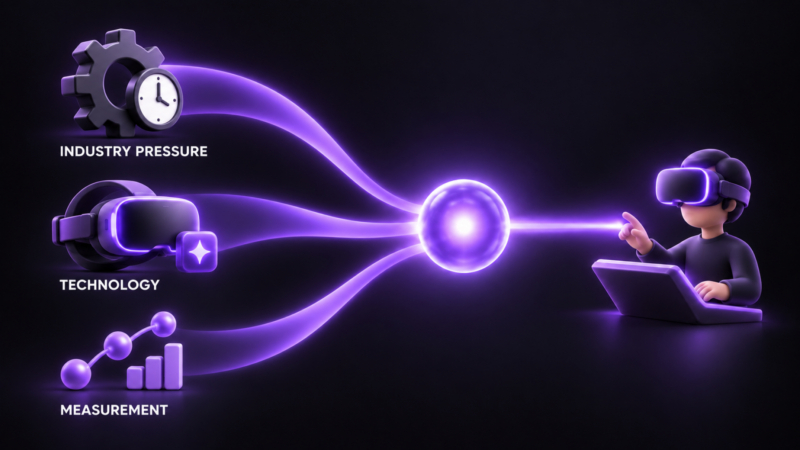
I told the students I think we’re at a genuine inflection point for serious games, and I put it down to three things converging at once.
First, pressure from industry itself. Machines and processes keep getting more complex, so the training required to run them safely keeps growing too – and companies need that training compressed into less time without cutting corners. Second, the technology has finally caught up: modern 3D engines, extended reality hardware, and AI-driven data systems now let us build training simulations that are immersive and believable enough to genuinely stand in for the real environment. Third, and this is the part I think gets underappreciated, the same technology lets us measure training in far more granular ways than before – not just pass or fail, but exactly where in the experience someone struggled, what decision led them astray, and what needs to change in the training itself to close that gap.
Put those three together and you get a perfect storm: demand, capability, and the tools to actually prove and improve outcomes, all arriving at the same time.
The Anatomy of a Serious Game
Whenever I sit down to design one of these experiences, I come back to the same structure:
A clear objective. The learner needs a genuine reason to be in the simulation – as concrete as landing a job, or as embedded as learning to operate a piece of equipment through a game that’s ostensibly about something else.
A decision-and-action loop. Once the objective is set, everything is built around the steps and choices a player has to take to reach it.
Feedback the player can act on. Learners need to understand clearly whether they succeeded, why, and what the consequences of failure are – and they need to be able to replay and try a different approach to see how the outcome changes.
Measurement beyond the outcome. Pass/fail isn’t enough. I want to log the granular detail – time to decision, behavioural patterns, team cooperation – and feed that into an analytics system that tells us precisely where an experience is failing to teach, so we can go back and fix that specific part.
Defence and Drones: Our Industry’s Hottest Niche
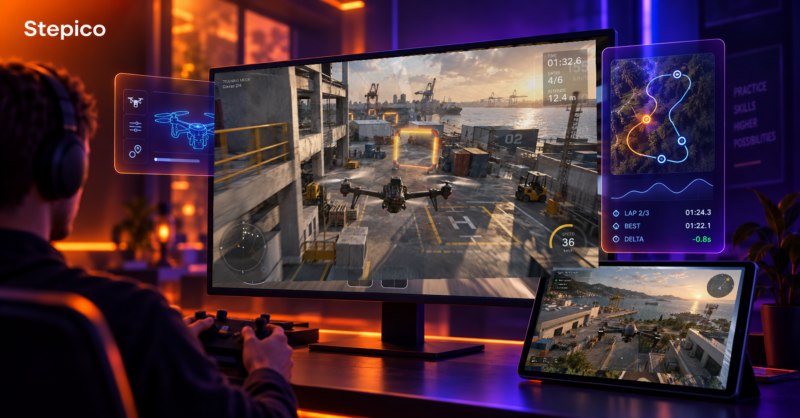
One sector came up again and again in the room: defence, and drone operation specifically. I explained why I think this space has become such fertile ground for serious games. Military training is inherently high-stakes, complex, and needs to adapt fast – but physical training grounds are expensive, slow to scale, and you can’t always run every scenario safely on a live range. Software scales in a way that live facilities simply can’t.
Drone piloting is a particularly clean fit for this. The job is, in large part, already a screen-and-controller experience, which means a virtual training environment can map almost one-to-one onto what a trainee will actually do in the field – same controls, same interface, same perceptual and navigational challenges – without the cost or risk of live flight.
GAMES EXAMPLES & Case Studies I Shared
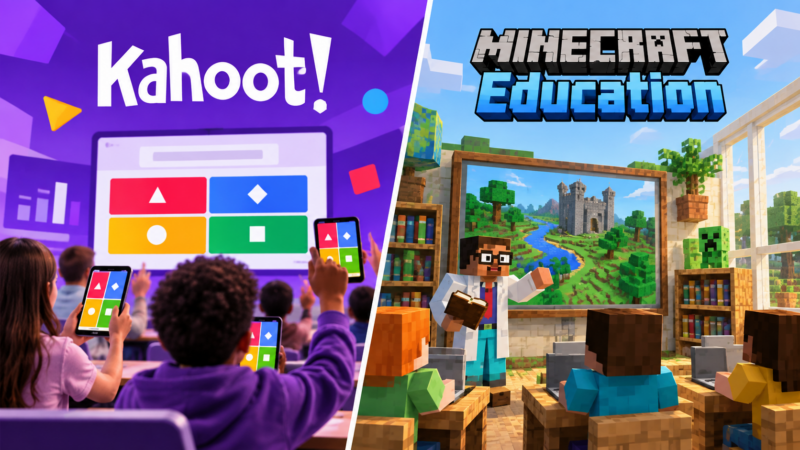
I walked the students through a mix of examples they’d likely recognise and some of our own client work, to show the range of what this category can do. Among world well-known examples I have chosen the following:
UAV Pro, a certified drone simulator used to license real-world drone pilots across FPV, aviation, and commercial applications.
Kahoot, which gamifies knowledge testing at classroom scale.
Minecraft Education, built by game designers who took Minecraft’s core mechanics and adapted them into a genuine classroom teaching tool.
Elder Quest, designed from the ground up as an educational experience, using role-playing and tabletop mechanics to build skills for caring for elderly and vulnerable people.
Microsoft Flight Simulator, one of the rare examples of something that’s simultaneously a beloved entertainment title and a respected cockpit simulator.
From our own portfolio, I talked about a project where we rebuilt a European university’s outdated, static online learning materials into an interactive, explorable virtual campus experience, designed so it could scale across other institutions in the EU. I also described a military client project I can’t name specifically, focused on team-based training: rather than testing an individual’s skills, we built the experience to observe and stress-test how trainee soldiers cooperate and behave as a unit, with an instructor able to manipulate the scenario on the fly to probe for weak points in their teamwork.
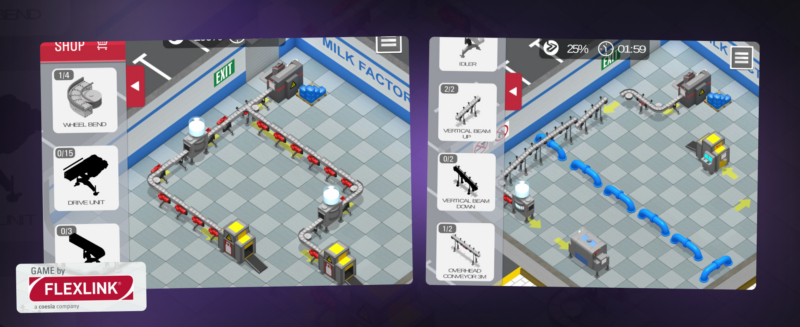
Two other projects showed the students how differently “serious” can look depending on what the client actually needs. For the Swedish logistics equipment company FlexLink, we built a city-builder-style factory game to onboard their sales and engineering staff, letting them experiment freely with the company’s product catalogue in a low-stakes, genuinely fun environment – appropriate there, because the goal was familiarity, not certification. By contrast, a project we did for a military enlistment centre used STEM and logic puzzles to engage prospective recruits during onboarding, while covertly using their in-game performance as a signal for enlistment officers – we never told candidates their score mattered, because telling them would have led them to game the system rather than reveal how they actually think.
How We Design These Experiences
A student asked how we approach a new serious game brief, and my answer was the same process I use every time: understand the client’s actual objective and the behaviour or skill they need built, then design the core interactive loop around that single goal before anything else. Only once that loop is proven do we scale outward – adding content, tooling, and analytics – while continuing to measure, tweak, and improve against the original objective. Everything else is secondary to getting that core loop right.
Where I Think This Is Headed
I closed with some speculation on where the category goes next. I think AI and extended reality are the two forces that will reshape serious games the most. As compute and reasoning capacity get cheaper, I expect AI to move beyond just helping us build these experiences and start acting as a live “proctor” – reading real-time data from a trainee and adjusting scenario parameters on the fly to stress-test exactly the behaviours that still need work. On the hardware side, XR keeps advancing (Valve’s newly announced headset is one example I mentioned) and will keep pushing immersion further, while better compute and bandwidth should let team-based simulations grow well past today’s typical cap of 10–30 participants – potentially, I think, to the scale of an entire factory floor.
What I Took Away From the Q&A
The session ended with an extended Q&A, and a few of my own answers stuck with me afterward:
It depends entirely on the objective. If I need to observe genuine, unfiltered behaviour, keeping the training context covert gives cleaner data – that’s what we did with the enlistment centre project. But if the goal is explicit skill-building on a tool or process, trainees need to know they’re in a safe space to experiment, or they won’t engage the way the training requires.
My first test is always legality – making sure the software we build can never be repurposed as an actual weapons-control tool. Beyond that, I believe transparency is the more ethical path. If someone is learning to carry out a real military mission, I think they deserve to be told plainly that the simulation reflects real-world consequences, not have it disguised as something lighter than it is.
I’m upfront that we don’t take on our clients’ business risk for them. What we do give them is the analytics to judge for themselves – user lifetime value, acquisition cost, the numbers that let them decide whether to scale, pivot, or sunset a product based on real data rather than a guess.
Treating a serious game like an entertainment product first. The moment a designer starts optimising for “what makes this more fun” over “what best teaches the intended behaviour,” the project has already drifted from its actual purpose. It’s a tempting trap for game designers – myself included, early on – because we’re trained to want people to enjoy what we build. But a serious game’s job isn’t to be liked. It’s to work.
Watch the Full Session
This piece only covers the highlights – the full lecture, including the complete Q&A with UTS students, is available to watch here: Serious Games in Practice: Turning Simulation into Training Impact.