
We establish the core product logic: what kind of game this is, who it’s for, what business goal it serves, and what constraints already exist around platform, budget, timeline, and content scope. This creates a shared foundation for every decision that follows.

Stepico
discovery phase in game development
Turn Your Game Idea Into a Production-Ready Concept
Most game projects don’t fail from poor execution – they fail because development starts before the concept is clear enough to build on. Stepico’s pre-production consulting and game discovery service solves that. We help studios, founders, publishers, and brands define what their game actually is, what the first build should prove, and what the path to prototype or production should look like – before costly development begins.
Most game projects don’t fail from poor execution – they fail because development starts before the concept is clear enough to build on. Stepico’s pre-production consulting and game discovery service solves that. We help studios, founders, publishers, and brands define what their game actually is, what the first build should prove, and what the path to prototype or production should look like – before costly development begins.
Is Your Game Idea Ready for Development?
This service is designed for teams that have a promising game direction but aren’t yet ready to hand it to a development team. You may have a strong concept, a business goal, or a market opportunity — but the details that turn that into a producible game still need to be defined.
This is especially relevant if:
- Your concept is still evolving and requirements aren’t stable yet
- You need a clearer product direction before pitching to investors or publishers
- Your internal stakeholders aren’t fully aligned on what’s being built and why
- You need better inputs for scope, budget, and timeline planning before committing to a full build
- You want a structured separation between concept definition and development execution

What the Discovery Phase Includes
Our game discovery engagement produces concrete, usable outputs — not just meeting notes. Every deliverable is designed to support alignment, planning, and a cleaner move into prototype or production.
Product & Requirements Clarification
Core Gameplay & Direction Definition
We define the player experience at its core: the gameplay loop, essential mechanics, and what makes the concept distinct enough to justify development. We also identify what absolutely needs to be in the first playable version — and what should wait.
Game Design Foundations
We produce the foundations of a game design document (GDD): setting, rules, core systems, progression logic, and the unique value proposition. This isn’t documentation for its own sake — it’s enough structured definition for the concept to be reviewed, estimated, and handed off without re-explanation.
Visual Basics & Art Direction
Early visual thinking prevents costly downstream rework. We produce moodboards, style references, and early art direction inputs that help stakeholders align faster and make art exploration more efficient — particularly when publisher approval or investor review is in scope.
High-Level Technical Approach
We identify likely implementation challenges, platform-specific considerations, and key architectural decisions early. This isn’t full technical design — it’s enough thinking to surface the risks that need to be resolved before development expands.
Prototype Scope Recommendation
One of the most valuable outputs of the discovery phase is a clear recommendation for what the first build should prove — and what it should deliberately leave out. We define the purpose of the prototype, the questions it should answer, and the features that belong to a later stage. A useful prototype is small, sharp, and decision-oriented. Discovery gets it there.
Success Metrics & KPI Benchmarks
We help define the key performance indicators your first build should be measured against — before a single line of code is written. Setting benchmark targets for retention, session length, conversion, or other relevant metrics during discovery means your team knows what ‘success’ looks like for the prototype from day one.
Ready to Define Your Game Concept?
If you have a game idea and need a clearer scope, a structured direction, and the right next step before development starts — that’s exactly what this engagement is built for.
Get in touch to discuss your concept and find out what the discovery phase would look like for your project.
Get in touch to discuss your concept and find out what the discovery phase would look like for your project.
Why Define Your Game Before Development Starts

Why Define Your Game Before Development Starts
Moving directly from idea to build feels faster. In practice, it often creates the most expensive problems: misaligned stakeholders, unstable scope, rework mid-production, and estimates that don’t survive contact with reality. A structured game discovery phase fixes those problems before they happen.
Reduce ambiguity before it becomes rework
An unresolved question during concept work can become weeks of redesign during production. Discovery surfaces those questions early, while the cost of resolving them is still low.
Align stakeholders around a shared product vision
Founders, publishers, internal product teams, and development partners often describe the same game in very different terms. Discovery converts those differences into a concrete, reviewable format — so decisions are based on shared understanding, not assumption.
Plan more responsibly
Budget estimates and timelines are only as reliable as the product definition behind them. Discovery gives planning firmer ground by clarifying scope, priorities, and what the first milestone should actually cover.
Choose the right first build
Not every project needs the same next step. One team may need a proof of concept. Another may need a gameplay prototype. Another may need a stronger pitch package. Discovery defines the purpose of that next step so the team is solving the right problem first.
Prepare for investor or publisher conversations
A documented concept with defined scope, early visual direction, and a clear path to prototype is significantly more compelling than an idea explained in a meeting. Discovery creates the foundation for those conversations.
How the Discovery Phase Works at Stepico
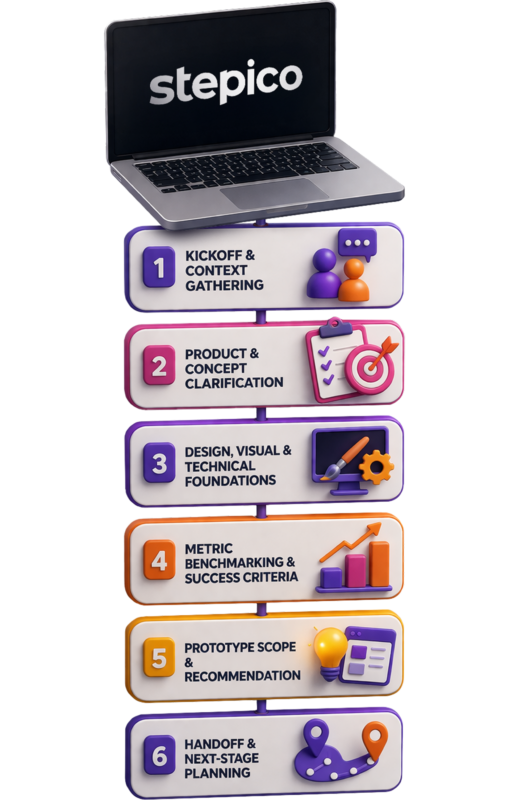
How the Discovery Phase Works at Stepico
Every discovery engagement is structured around your project’s specific context — the concept, the team, the stage, and the next milestone you’re working toward. The process typically follows these stages:
1. Kickoff & Context Gathering
We begin with a structured intake: your game concept, business goals, target audience, platform assumptions, and any constraints already in play. This gives us the context to run the engagement productively.
2. Product & Concept Clarification
Working with your team, we define the core product direction: what the game is, what makes it compelling, who it’s for, and what it needs to prove. We challenge assumptions, identify gaps, and build consensus around a shared concept.
3. Design, Visual & Technical Foundations
Our game designers, artists, and technical leads develop the foundational outputs: design documentation, moodboards and art direction, and a high-level technical approach. Each is tailored to the concept and the next phase of work.
4. Metric Benchmarking & Success Criteria
We define the KPIs and benchmark targets your first build will be measured against – retention curves, session depth, conversion triggers, or other metrics relevant to your game and business model. This gives your team a clear definition of what the first build needs to prove.
5. Prototype Scope & Recommendation
We deliver a clear recommendation for what the first build should include, what it should leave out, and what questions it needs to answer. The output is a scoped, purposeful next step – not an open-ended brief.
6. Handoff & Next-Stage Planning
We review all outputs together, align on the path forward, and prepare the materials your team or development partner needs to proceed with confidence. If you’re moving into prototype or production with Stepico, this handoff is seamless.
From First Build to
First Players
Defining a game concept is only part of making the first build successful. Two things often get missed during early-stage work: knowing how to measure whether the first build worked, and knowing how to get the right players in front of it.

Success Metrics & KPI Benchmarks
We work with your team to define the specific performance benchmarks your prototype or first build will be evaluated against. Whether that’s Day-1 retention, session length, tutorial completion, or monetization entry points – having those benchmarks set before the build begins means your team spends time on what matters, and your review conversations are grounded in data rather than gut feel.

Access to Trusted User Acquisition Partners
Stepico has established relationships with proven User Acquisition partners who specialize in early-stage game campaigns. If your project needs to validate metrics with real players – or attract the right audience for your first launch window – we can connect you with the right support. This is particularly useful for teams approaching publisher conversations or soft-launch planning.
READY TO DEFINE YOUR GAME CONCEPT?
If you have a game idea and need a clearer scope, a structured direction, and the right next step before development starts – that’s exactly what this engagement is built for.
Get in touch to discuss your concept and find out what the discovery phase would look like for your project.
Get in touch to discuss your concept and find out what the discovery phase would look like for your project.

Why Stepico
Stepico brings over 10 years of hands-on game development experience to every discovery engagement. Our team includes game designers, artists, and technical leads who have shipped games across mobile, PC, and blockchain platforms – for clients including NBCUniversal, Gameloft, and Immutable.
That means the strategic pre-production work we do is grounded in what actually happens in production. We don’t just help you define the concept – we define it in a way that makes the next phase easier to execute, estimate, and deliver.
That means the strategic pre-production work we do is grounded in what actually happens in production. We don’t just help you define the concept – we define it in a way that makes the next phase easier to execute, estimate, and deliver.








10+
years of experience
200+
enthusiasts on-board
>100
games produced
FREQUENTLY ASKED QUESTIONS
What is the game discovery phase and why does it matter?
The game discovery phase is an early-stage pre-production process that defines and validates a game concept before development begins. Its purpose is to answer the questions that determine whether a project is ready to move forward: What is the game, exactly? Who is it for? What should the first build prove? What are the main risks? Without this work, teams often start building before they have enough clarity on what they’re building – which leads to rework, misaligned stakeholders, and estimates that collapse mid-production.
What does Stepico deliver at the end of a discovery engagement?
You receive a complete pre-production package tailored to your project. This typically includes a clarified product and requirements brief, core gameplay and direction definition, game design foundations (GDD basis), moodboards and early art direction, a high-level technical approach, defined KPI benchmarks for your first build, and a prototype scope recommendation. The package is designed to support planning, estimation, stakeholder communication, and a clean handoff into the next phase.
How long does a discovery phase take?
Scope varies by project complexity, but most discovery engagements run between 2 and 6 weeks. Simpler concepts with clearer starting conditions move faster. Projects involving multiple stakeholders, novel mechanics, or complex technical questions may require more time to define properly. We scope each engagement based on your concept and goals during the initial conversation.
Do I need to have a detailed concept before starting?
No. Discovery is designed for concepts that are still evolving. You don’t need a complete game design document or a locked spec to begin – in fact, that’s exactly why the discovery phase exists. What you do need is a game idea with some business or creative direction behind it, and a clear next milestone you’re working toward (investor pitch, prototype, publisher review, or production start).
How is discovery different from a prototype, POC, or MVP?
These are distinct stages with different purposes:
- Discovery defines what the game is and what should be built first. The output is documentation and a structured product direction – not a build.
- Proof of Concept (POC) validates a specific technical assumption – such as networking feasibility or rendering performance.
- Prototype tests whether the gameplay, interactions, or mechanics work in practice. It’s a playable build used to learn and refine.
- MVP is the simplest version of the product that validates a hypothesis with real users or stakeholders.
Discovery comes first because it defines what the prototype, POC, or MVP should prove. Stepico offers prototype and MVP development as separate services – you can learn more on their respective pages.