
3D animation shows up in more places than most people realize. It’s in the survival game you played last weekend, the product explainer on a hardware startup’s homepage, the architectural render your city council approved last month, and the surgical training video a hospital ran for new residents. The technology is the same; the intent, style, and technique behind each use case are not.
If you’re evaluating a production pipeline, briefing an outsourcing partner, or just trying to make sense of how modern animation actually works, understanding the distinctions matters. This guide covers the main types of 3D animation, the core 3D animation techniques driving them, and how they play out across industries — with a focus on video games, where the demands are arguably the most complex.
What Is 3D Animation?
At its most basic, 3D animation is the process of making digital objects move inside a three-dimensional virtual space. Unlike flat 2D animation, 3D models exist in virtual environments that can be viewed, lit, and rendered from any angle — giving artists far more control over how scenes look and behave.
A standard 3D animation pipeline runs through modeling, texturing, rigging, animation, lighting, rendering, and post-production. In practice, these stages overlap and iterate constantly, especially in game development where performance constraints affect decisions all the way back to the modeling phase.
The range of what falls under “3D animation” is genuinely wide. Character performances, physics-driven destruction, motion graphics for a product launch, a walkthrough of a building that doesn’t exist yet — all of these are 3D animations, built with overlapping toolsets but toward very different ends.
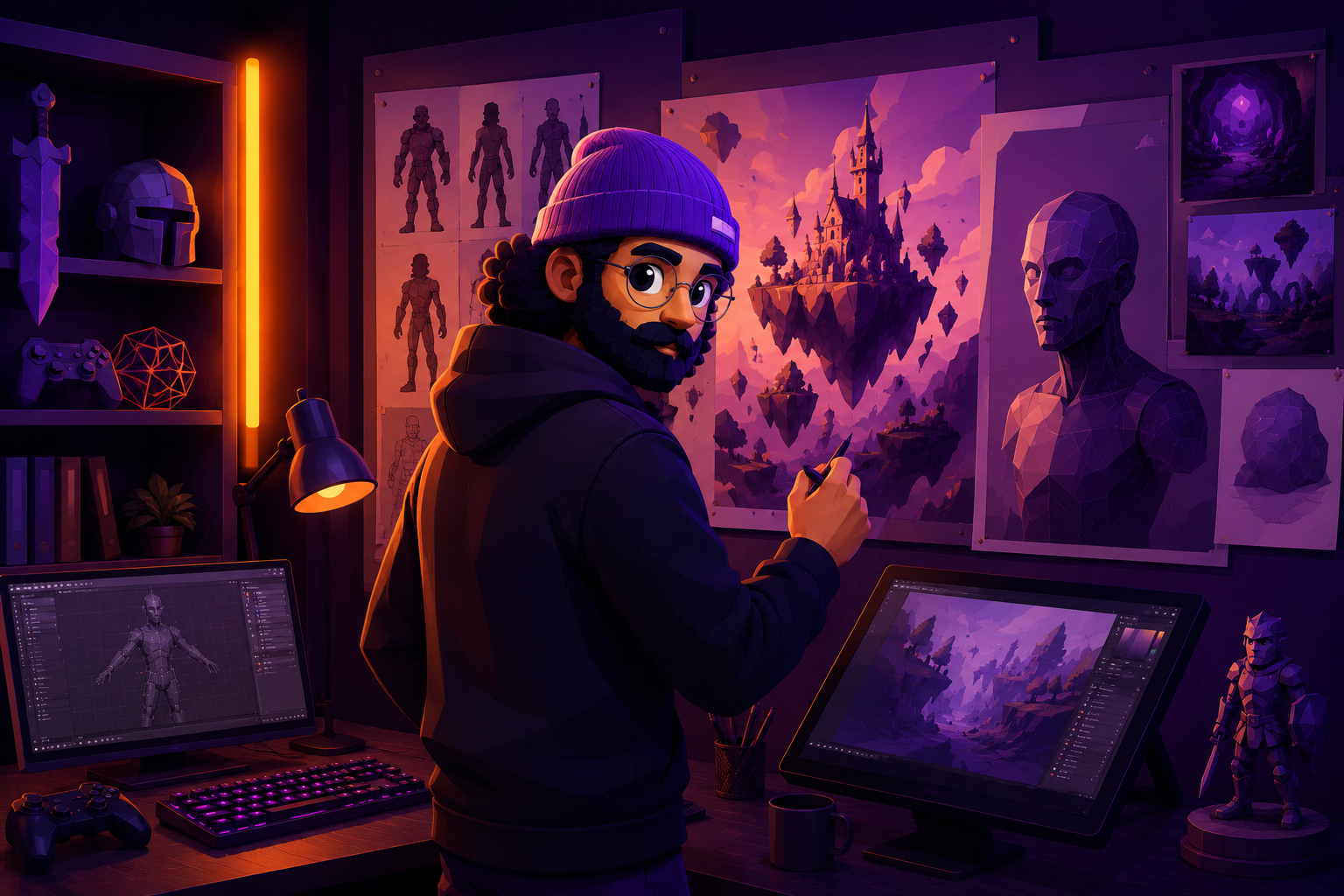
Main Types of 3D Animation
The type of animation refers to what’s being animated — characters, machines, data, environments. Technique (covered in the next section) refers to how movement is created. Most productions mix both, but it helps to understand each category on its own terms.
Character Animation
Character animation is what most people picture when they think about 3D animation — a digital figure that walks, talks, fights, reacts, and (when done well) feels believably alive. It spans everything from playable game protagonists to NPCs with idle behaviors to fully animated film characters with nuanced emotional performances.
The craft sits at the intersection of technical skill and performance instinct. Good character animators think like actors: weight shifts, anticipation frames, the way a character’s posture changes before they speak — all of this communicates more than the words or actions themselves. Facial animation has become increasingly central to this, especially in narrative games where close-up dialogue scenes live or die on whether the character’s eyes and mouth feel synchronized and real.
Animation rigging is the foundation that makes character animation possible. A well-built rig gives animators clean controls over every part of the model — without it, even great keyframe work falls apart in motion.
Mechanical Animation
Mechanical animation deals with machines, vehicles, robotic systems, and engineered components. The priorities here are almost the opposite of character work: instead of emotional expression and organic movement, the goal is accuracy, logic, and functional realism.
This type of animation is common in manufacturing training, aerospace visualization, robotics demonstrations, and vehicle simulations. Animators working in this space often collaborate closely with engineers to ensure that moving parts are mechanically plausible — an assembly sequence where bolts tighten in the wrong order or a piston that moves at the wrong ratio will get caught immediately by the technical teams who use these animations.
Motion Graphics Animation
Motion graphics animation combines 3D elements with graphic design principles — shapes, typography, data, branded visuals — to communicate information quickly and cleanly. Think broadcast channel bumpers, product launch videos, infographic-style explainers, or the animated title sequences that now open most streaming shows.
Unlike character-driven work, motion graphics isn’t usually about storytelling through performance. It’s about directing attention, reinforcing a brand’s visual identity, and making complex information land in a few seconds. The rise of short-form video across social platforms has massively expanded demand for this style, and many studios now maintain dedicated motion graphics pipelines alongside their character and environment work.
Visual Effects (VFX) Animation
VFX animation covers computer-generated effects that enhance or complete a scene — explosions, fire and smoke, water, destruction, atmospheric weather, magical effects, and digital creatures that would be impossible or prohibitively expensive to produce practically.
In film and TV, VFX teams are responsible for the kind of scenes that define big-budget productions: the crumbling city block, the dragon that actually looks like it has weight, the weather system that feels genuinely threatening. In games, the role is equally important, though the constraints are different. Spell effects, combat feedback, particle systems, and environmental interactions all need to read clearly at gameplay speed, not just look good in a cutscene. That balance between visual quality and real-time performance is one of the core engineering challenges in game VFX.
Architectural Animation
Architectural animation is exactly what it sounds like: animated visualizations of buildings, interiors, and urban environments, typically created before the physical thing exists. Architects, developers, and real estate firms use these to walk clients through a project in a way that static renders can’t achieve — showing how light moves through a space during the day, how traffic flows around a new development, or what a neighborhood looks like from street level.
From a sales and stakeholder communication standpoint, a good architectural animation is genuinely powerful. It closes the perceptual gap between a blueprint and a building, which matters when you’re asking investors or planning committees to commit to something they can’t yet see.
Product Animation
Product animation shows what a product does, how it works, and why it matters — often in ways that physical demos or photography can’t match. Internal component breakdowns, assembly sequences, interaction flows, and use-case walkthroughs are all standard applications.
For tech, medical device, and automotive companies in particular, product animation has become a core part of both marketing and sales collateral. It lets you show a surgical device’s mechanism without a cadaver in the room, or demonstrate a car’s structural safety features without cutting one in half. At early product stages, it removes the need for a physical prototype entirely — you can put a photorealistic animation of a product in front of investors before manufacturing has started.
Popular 3D Animation Techniques
If animation types describe what is being animated, techniques describe how movement is actually generated. The three dominant 3D animation styles in modern production are keyframe animation, motion capture, and procedural animation — and most serious productions use combinations of all three.
Keyframe Animation
Keyframe animation is the foundational 3D animation style: an animator manually defines the character or object’s position, rotation, and other properties at specific moments in time (the keyframes), and the software interpolates the motion between them. Everything else builds on this.
The major advantage of keyframe animation is control. An animator can push movement into stylized territory, exaggerate timing for comedic or dramatic effect, or dial back physicality to create something dreamlike — things that motion capture can’t do naturally. It’s also the right tool when you don’t have an actor available (try capturing motion for a quadruped or a non-humanoid creature), and for cutscenes where the camera angles and character performances need to be choreographed with precision.
The tradeoff is time. Animating a character’s full locomotion set by hand — walk, run, sprint, crouch-walk, climb, dodge — takes significantly longer than capturing the same set with an actor on a mocap stage. For projects with large animation budgets and stylistic ambitions, that cost is worth it. For projects prioritizing naturalism and scale, motion capture often makes more sense.
Keyframe animation is also the natural home for stylized movement — exaggerated arcs, snappy timing, and deliberate weight that doesn’t try to look photorealistic. That choice is inseparable from the broader art direction of the project; if you’re figuring out where your game sits on that spectrum, our stylization vs realism in game art breakdown is a good starting point.
Motion Capture Animation
Motion capture records the movement of real performers using sensor-equipped suits or marker-based optical systems, then maps that data to digital characters. The result is movement that carries the idiosyncrasies and weight of actual human bodies, which is extremely difficult to replicate through pure hand animation.
Modern AAA games use motion capture as a matter of course — not just for cinematics, but for in-engine gameplay animations, facial performances captured via head-mounted cameras, and even stunt work. The entire 3D animation technology has also become more accessible at the lower end, with inertial mocap systems that don’t require a dedicated stage now within reach for mid-size studios.
One thing worth knowing: raw mocap data is never clean. It always requires cleanup, retargeting to fit the specific character’s proportions, and often significant hand-animation passes to make transitions feel smooth and game-ready. Mocap is a starting point, not a finished product.
Procedural Animation
Procedural animation uses algorithms and simulation rules to generate movement automatically, rather than having an animator define it. Instead of hand-keying how a character’s feet interact with uneven terrain, a procedural system calculates that contact in real time based on the ground geometry. Instead of animating a crowd of 500 characters individually, a procedural system gives each one behavioral logic and lets them move within defined parameters.
This approach is particularly valuable in games, where the world is dynamic and the player’s actions are unpredictable. Procedural systems handle physics-driven cloth and hair, inverse kinematics for foot placement, crowd and foliage animation, and environmental interactions that would be impossible to manually keyframe at scale. As open-world games grow in size and complexity, procedural animation has shifted from a nice-to-have to a production necessity.
The catch is that procedural systems are complex to build and debug. They require close collaboration between animators and technical directors, and when they break, they can break spectacularly.
Examples of 3D Animation Across Industries
It’s worth being concrete about how different types of animation styles land in practice, outside of games.
In film and streaming, studios use character animation and visual effects animation in combination — a live-action set extended with CG environments, a digital double replacing an actor for a dangerous stunt, a creature built entirely in 3D that shares the frame with real performers. The pipeline is enormous, and the budgets reflect it.
In healthcare, mechanical animation and product animation are used to train surgical teams on new instruments, walk patients through procedures before they happen, and help device manufacturers demonstrate complex implant mechanics to approval boards. The animation doesn’t need to be cinematic; it needs to be accurate.
In manufacturing and engineering, mechanical animation handles assembly visualization, machine operation training, and safety procedure documentation — often replacing physical demonstrations that would require expensive downtime on production lines.
In architecture and real estate, architectural animation serves as the primary sales tool before ground is broken. A convincing walkthrough can move a development from planning approval to presales, which makes the cost of a high-quality animation easy to justify.
Types of 3D Animation Used in Video Games
Game development is where the demands on animation get genuinely complicated. Unlike film, which is linear and pre-rendered, games require animation that runs in real time, responds to player input at any moment, and does so without destroying frame rate. That changes everything about how animation is planned, built, and optimized.
Gameplay Animation
Gameplay animations are what the player interacts with constantly — locomotion, combat actions, weapon handling, climbing, dodging, interacting with objects. These animations need to feel responsive above almost everything else. A sword swing that’s two frames late doesn’t just look bad; it feels wrong and breaks the player’s sense of agency.
Getting gameplay animation right usually involves substantial state machine work: defining how the character transitions between hundreds of possible animation states depending on what the player is doing, what’s happening in the environment, and what other systems are running simultaneously. It’s as much systems design as it is animation craft.
Character and Facial Animation
Narrative-driven games have pushed character animation and facial animation to a level that rivals film production. Dialogue systems, companion AI, branching storylines — all of these require characters who can perform emotional range convincingly. Studios working on this kind of content typically combine mocap for body performance with dedicated facial capture systems, then layer hand-animation on top to hit specific story beats.
NPCs have their own animation requirements: idle behaviors, crowd systems, reaction animations, ambient loops that make the world feel populated without every character demanding individual attention.
Cinematic Animation
In-engine cinematics bring together keyframe animation, motion capture, facial performance, visual effects, and lighting in a way that needs to be competitive with standalone CGI. The challenge in games is that these sequences often need to transition directly into gameplay — which means the character leaving the cutscene needs to land in the exact position and state that gameplay logic expects. That handoff is one of the trickier technical problems in game animation.
Environmental and Effects Animation
Environmental animation is what makes a game world feel alive: dynamic weather, swaying vegetation, water surfaces, ambient particle effects, destruction systems. These run constantly in the background, so optimization is critical — a beautiful swaying grass system that kills frame rate on older hardware isn’t a solution.
Visual effects animation in games operates under tighter performance budgets than film VFX, but the visual bar has risen dramatically. Spell effects, combat feedback, environmental interactions — all of these are part of the player’s second-to-second experience and contribute significantly to how a game feels, not just how it looks.
Real-Time Constraints
Everything described above has to run inside a real-time render budget. That constraint — typically 16ms per frame at 60fps — shapes every animation decision in games, from the polygon count on a character model to how many particles a spell effect can spawn. Studios that do this well maintain tight feedback loops between animators, technical artists, and engine programmers, and often build custom tooling to profile and optimize animation systems as they go.
For studios that need to scale this kind of work without expanding their internal team, dedicated outsourcing partners can carry significant parts of the animation pipeline. Stepico’s 3D animation services cover character animation, real-time asset production, game cinematics, and full pipeline support — which is worth knowing if you’re looking at a production scope that exceeds what your in-house team can absorb.
Conclusion
The range of what 3D animation covers — from a character’s blinking idle in an RPG to a surgical device walkthrough to a building that doesn’t exist yet — reflects how fundamental movement and visual storytelling have become to how we communicate and create. Understanding the different types of 3D animation and the techniques behind them isn’t just useful for trivia: it directly affects production decisions, outsourcing briefs, timelines, and budgets.
For game developers specifically, animation isn’t a finish layer you apply at the end — it’s baked into the engine architecture, the design systems, and the player experience from the start. Getting it right requires the right people, the right tools, and often the right external partners.
If your current project is outpacing your internal animation capacity, it’s worth talking to a team that specializes in exactly this. Stepico offers 3D animation services built specifically for game production — character animation, real-time assets, cinematics, and full pipeline support for studios that need to move fast without cutting corners on quality.
FAQ
What are the main types of 3D animation?
The main categories are character animation, mechanical animation, motion graphics animation, visual effects animation, architectural animation, and product animation. Most productions combine several of these within a single project.
What is the most widely used 3D animation technique?
Keyframe animation remains the baseline technique across the industry — it gives animators direct control over movement and works for virtually any animation type. Most productions layer it with motion capture or procedural systems depending on the project’s needs.
What is motion capture animation?
Motion capture animation records the movement of real performers using sensor-based suits or optical tracking systems and maps that data to digital characters. It produces naturalistic movement efficiently but always requires cleanup and retargeting work before it’s production-ready.
What is procedural animation?
Procedural animation generates movement through algorithms and simulation rules rather than manual keyframing. It’s widely used in games for locomotion systems, physics interactions, crowd behavior, and environmental effects — anywhere the sheer volume of animation makes hand-keying impractical.
How is 3D animation used in video games?
Games use animation across gameplay locomotion, combat systems, character performances, cinematic sequences, environmental effects, and UI interactions — all running in real time and responding dynamically to player input.
What industries use 3D animation outside of gaming?
Film, television, architecture, real estate, healthcare, manufacturing, engineering, advertising, and product development all rely heavily on 3D animation for different purposes and with different technical requirements.