

For years, the mobile games industry was driven by growth. More downloads, more users, more markets opening up. Success often came down to how efficiently a studio could acquire players at scale. That logic no longer holds.
The latest Sensor Tower insights — combined with real production-side observations — point to a clear shift. Mobile gaming has entered a new phase, where mobile game retention defines success far more than installs. The market hasn’t collapsed, but it has matured. And in a mature market, the rules change.
Today, studios are no longer competing to be discovered. They are competing to be remembered.
What Is the “Retention Era” in Mobile Gaming?
The “retention era” refers to a shift in the mobile game revenue model, where success depends less on installs and more on how long players stay engaged.
In practical terms: downloads are stabilizing or declining, mobile gaming revenue growth is slowing, competition is increasing, and player attention is fragmented across apps, social media, and games. As a result, player retention has become the primary driver of mobile game earnings.
Historically, mobile success could be driven by high install volumes, aggressive user acquisition, and ad-based monetization. Today, that model is less reliable. Players are less likely to try new games, acquisition costs are higher, and revenue increasingly depends on long-term engagement. This is why game retention metrics — especially D1, D7, and D30 — now play a central role in evaluating mobile game financial performance.
State of Mobile Gaming Revenue in 2026
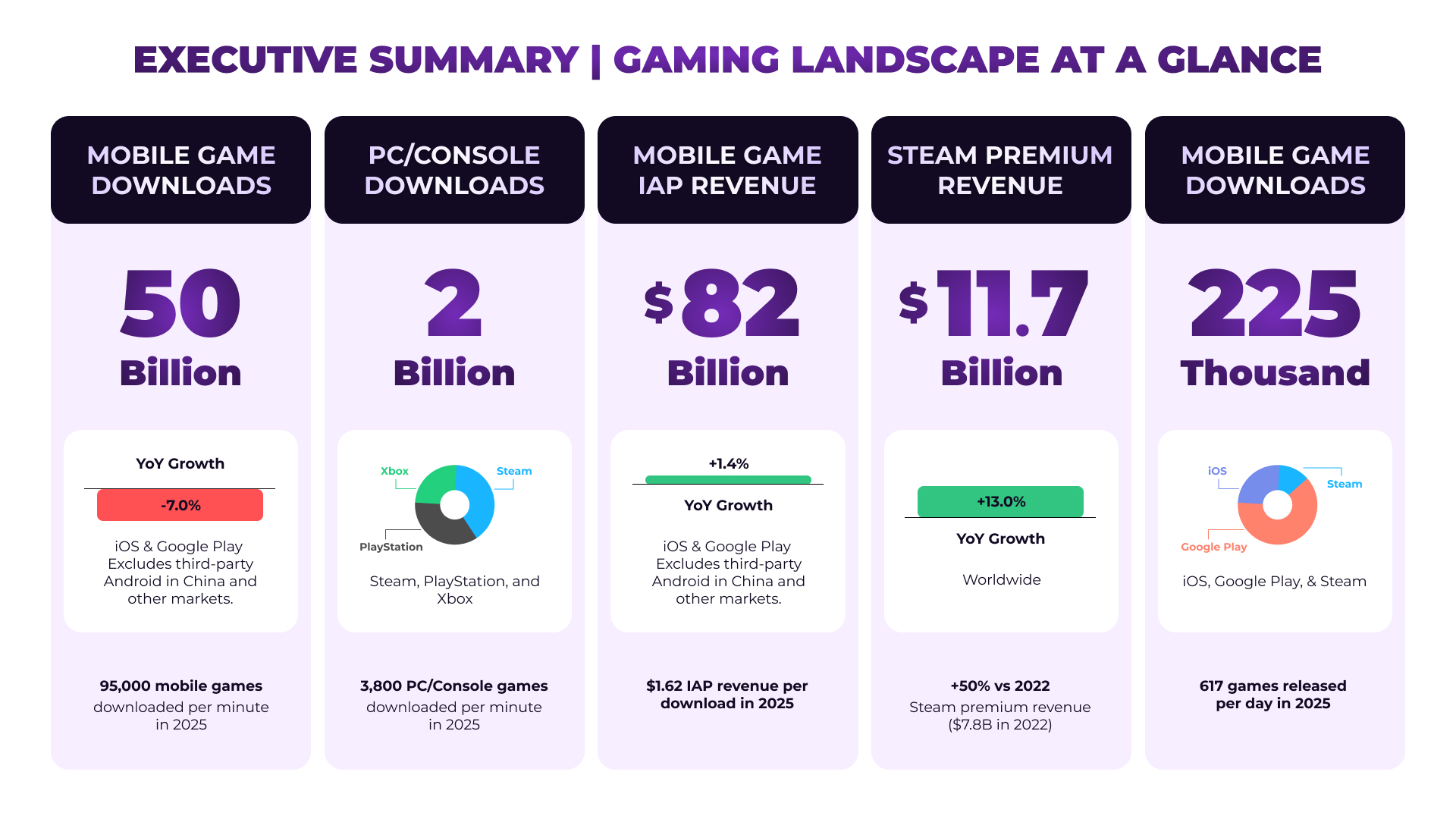
Sensor Tower data highlights a key reality: the mobile gaming market revenue has reached a level of maturity. Total revenue remains high but relatively stable, growth is incremental rather than exponential, and top-performing titles dominate earnings.
At the same time, another important shift is underway: mobile apps outside gaming are growing faster in revenue than games. This signals increased competition not just between games — but across the entire mobile ecosystem.
What this means for studios is direct. Mobile game revenue models must evolve, new titles face higher barriers to entry, and existing games must extract more value over time. In other words, how mobile games make money is changing — from short-term spikes to long-term monetization.
Why Retention Is Now Core Revenue Driver
Retention directly impacts every major component of mobile game monetization.
Higher lifetime value (LTV). The longer a player stays, the more likely they are to make purchases, engage with events, and convert multiple times. This increases mobile game lifetime value, which is the foundation of sustainable mobile game income sources.
More effective monetization systems. Retention enables battle passes, daily rewards, seasonal content, and social systems — all essential to modern mobile game revenue streams, especially in free-to-play environments.
Stronger in-app purchase performance. In-app purchase revenue for mobile games depends heavily on ongoing engagement. Without retention, players churn before converting and monetization systems underperform. With retention, conversion rates improve, mobile game microtransactions revenue increases, and spending behavior becomes predictable.
Declining Retention and What It Signals
One of the most important findings from recent data is that retention is not improving — it is declining in many segments. Casual games have seen notable drops in D7 retention. Midcore games are experiencing long-term engagement decline. Even established genres are under pressure.
This reflects broader changes in player behavior: less willingness to commit to new games, more competition for attention, and higher expectations for content and progression.
The takeaway for studios is clear. Retention is not just important — it is becoming harder to achieve. That makes it a key differentiator in mobile game financial performance and a direct variable in mobile gaming profit trends.
Rise of Hybrid-Casual and Retention-Oriented Design
One clear response to declining retention is the rise of hybrid-casual games. These combine simple core mechanics for easy onboarding with deeper progression systems designed to drive long-term engagement.
Compared to traditional casual games, hybrid-casual titles retain players longer, generate stronger free-to-play mobile revenue, and support more advanced mobile game monetization strategy. Players today expect more than a single mechanic — they respond to progression systems, social features, regular updates, and personalization.
This is why modern mobile game revenue drivers are increasingly tied to retention design rather than pure acquisition volume. What may feel excessive from a user perspective — daily rewards, limited-time offers, deep progression tracks — is a deliberate, data-backed response to declining engagement. The mobile game economy is now built around these systems.
LiveOps: The New Core of Mobile Game Revenue
If retention is the goal, LiveOps is the tool that makes it possible.
Modern games are not finished at launch. They evolve continuously through events, updates, and content drops. This ongoing layer — live operations — is now central to mobile game revenue optimization. It’s no longer enough to release a polished product. A successful game must introduce new content regularly, re-engage inactive players, and create reasons to return daily, weekly, and monthly.
This matters especially because acquiring new users has become more expensive and less predictable. As a result, studios are increasingly focused on maximizing value from existing players rather than constantly chasing new ones.
The mobile game revenue breakdown reflects this shift. Mobile game earnings are increasingly tied to how well a team operates the game after release — not just how well they built it before launch. LiveOps drives conversion spikes, extends lifecycle value, and keeps monetization cycles active long after the initial release window.
The Changing Mobile Game Revenue Model
The traditional mobile game revenue model — based on scale and ads — is evolving.
The old model relied on high install volume, ad-driven revenue, and a short player lifecycle. The modern model is defined by lower install growth, mixed monetization (ads plus IAP), and a long-term engagement focus.
Today’s mobile game revenue breakdown typically includes in-app purchases as the primary driver, ads as supporting revenue, and LiveOps events as conversion spikes. The key shift: success is no longer about reaching millions of players — it is about maximizing value per player. Mobile game pricing models are adapting accordingly, moving away from simple ad-fill toward segmented offers, subscriptions, and engagement-gated monetization.

Competition Is No Longer Just Other Games
One of the most overlooked changes in mobile gaming trends for 2026 is the rise of non-gaming competition. Players now choose between playing a game, watching short-form content, using utility apps, and engaging on social platforms.
This affects session length, retention rates, and monetization opportunities in ways that did not exist a few years ago. Games must now compete on convenience, engagement speed, and reward frequency. This is reshaping mobile game purchase behavior and expectations across the board — players who are not engaged early simply never reach monetization touchpoints.
As a result, retention and monetization are no longer separate problems. They are tightly connected variables in a single system.
What This Means for Game Development Strategy
The retention era forces a fundamental shift in how games are built and operated.
Design for retention from day one. Retention is not a post-launch fix. Core loops, progression systems, and reward structures must support long-term engagement from the start. It is the foundation, not a feature layer on top.
Prioritize long-term monetization. Attempting to maximize early revenue at the cost of retention often leads to weaker long-term performance. Sustainable mobile game monetization strategy depends on building trust and habit before pushing for conversion. Focus on repeat purchases, engagement-driven spending, and lifecycle value.
Invest in LiveOps as a core capability. This includes not just content production, but also analytics, segmentation, and experimentation. The ability to react to player behavior in real time is becoming a genuine competitive advantage and a direct lever on mobile app game earnings.
Reassess risk in new projects. Launching a new game in a saturated market carries more risk than ever. In many cases, investing in the growth and optimization of existing titles can deliver more predictable returns. Studios should actively balance new development against scaling what already works.
Conclusion: From Launch Success to Lifecycle Success
The mobile gaming industry has not slowed down — it has evolved. The focus has shifted from growth to sustainability, from acquisition to retention, from short-term performance to long-term value.
Understanding mobile game revenue statistics today means accepting that revenue is no longer front-loaded. It accumulates over time, driven by engagement systems, LiveOps, and continuous interaction. The most successful studios are not those that launch the biggest games — they are the ones that build games players return to, again and again.
For studios and development teams navigating this shift, the path forward requires more than good game design. It requires strategic investment in retention mechanics, monetization architecture, and post-launch operations — often with the help of an experienced development partner who understands both the technical and business dimensions of building for the long term.
If your studio is working on a new title or optimizing an existing one for better retention and mobile game revenue optimization, Stepico’s team has the production experience to help you build systems that last — not just games that launch. Get in touch with us to discuss your project.
FAQ
What are the most important game retention metrics?
The most important game retention metrics are D1 (Day 1), D7 (Day 7), and D30 (Day 30). They measure how often players return after installing a game and serve as leading indicators of long-term mobile game financial performance.
How do mobile games make money today?
Modern mobile game revenue streams include in-app purchases, advertising, and LiveOps-driven events and offers. Most successful games combine all three, with IAP as the primary driver and LiveOps as the mechanism that sustains conversion over time.
Why is retention more important than installs?
Because installs alone do not generate revenue. Retention determines player lifetime value, conversion rates, and total mobile gaming revenue. Without it, even high install volumes fail to translate into sustainable mobile game earnings.
What is a hybrid-casual game?
A hybrid-casual game combines simple mechanics — similar to hyper-casual — with deeper systems such as progression, events, and structured monetization. This approach improves both retention and free-to-play mobile revenue, making it one of the strongest formats in the current mobile game economy.
What is the biggest challenge in mobile gaming today?
Keeping players engaged over time in an environment where competition is high, attention is fragmented, and player expectations are rising. Solving that challenge is what defines mobile game revenue optimization in 2026.