
The debate around remaster vs remake is often framed as a creative or technical distinction. In reality, for studios and publishers, it’s a business decision first — and a production choice second.
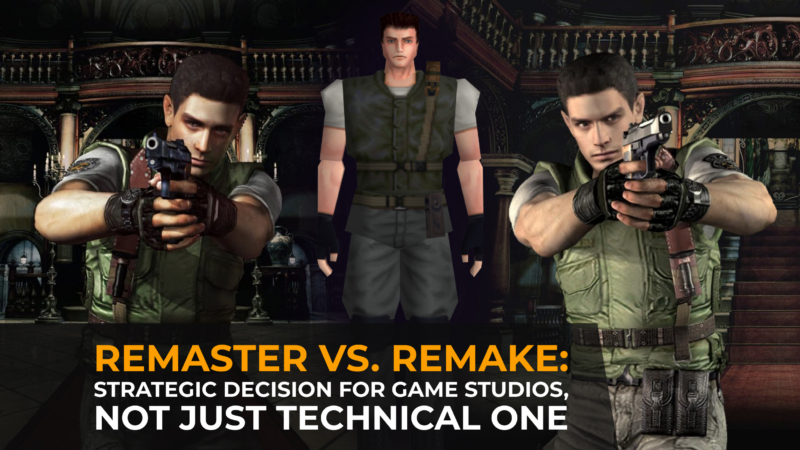
At a high level, the difference is straightforward. A game remaster improves an existing title — upgrading visuals, performance, and compatibility — while preserving the original experience. A game remake, on the other hand, rebuilds the game from the ground up, often reimagining gameplay, systems, and even narrative structure.
But in practice, the decision between a remake vs remaster shapes far more than the final product. It affects investment strategy, risk exposure, production timelines, and ultimately, how a piece of intellectual property performs in the market.
Why This Decision Matters More Than Ever
The resurgence of legacy IP in modern game development is not accidental. As production costs rise and competition intensifies, studios are increasingly looking inward — toward existing franchises with proven audiences.
Revisiting older titles offers a compelling value proposition:
- Built-in brand recognition
- Established player trust
- Reduced market uncertainty compared to new IP
However, not all legacy projects deliver the same return. Some remasters quietly extend a product’s lifecycle. Others generate short-term revenue but fail to expand the audience. Meanwhile, certain remakes redefine entire franchises and unlock new commercial potential.
The difference lies in choosing the right approach.

What Is a Game Remaster
A game remaster is essentially an upgrade. The core game remains intact, but its presentation and performance are brought up to modern standards.
This often includes improved textures, lighting, resolution, and framerate, alongside adjustments for new platforms. The original codebase, design systems, and gameplay loops typically remain unchanged.
From a business perspective, remasters are about efficiency and predictability.
They are commonly used to:
- Extend the lifecycle of successful titles
- Reintroduce games to new hardware ecosystems
- Maintain franchise visibility between major releases
- Generate revenue with relatively controlled investment
This is why remasters are often aligned with platform transitions. When a new console generation launches, remasters help fill content gaps while leveraging existing IP.
A well-executed remaster can be highly effective in this role. It gives players a familiar experience with improved quality, while allowing publishers to monetize their catalog without committing to full-scale development.
However, remasters have a natural ceiling. Because they rely on the original design, they rarely attract entirely new audiences. Their performance is closely tied to nostalgia and existing fan demand.
What Is a Game Remake
A game remake is a fundamentally different undertaking. Instead of upgrading existing assets, the game is rebuilt — often using modern engines, tools, and design philosophies.
This allows teams to:
- Rework outdated mechanics
- Redesign levels and pacing
- Update narrative delivery
- Align the experience with current player expectations
From a production standpoint, remakes often resemble new game development. The difference is that they are anchored in an existing IP.
This makes them a powerful tool for franchise repositioning.
A remake is not just about preserving a game — it’s about redefining its place in the market.
Consider how some high-profile remakes have functioned:
- Resident Evil 2 Remake didn’t just update visuals — it modernized the entire gameplay loop, introducing over-the-shoulder camera mechanics and rebalancing pacing. The result was not only commercial success but also a broader revitalization of the franchise.
- Final Fantasy VII Remake expanded the original into a multi-part, large-scale project, effectively transforming a legacy title into a modern blockbuster ecosystem.
These examples highlight a key point: remakes are often less about nostalgia and more about long-term value creation.

Remaster vs. Remake: The Real Business Trade-Off
At a surface level, the game remake vs remaster difference comes down to scope. But for decision-makers, the more important distinction is strategic intent.
A remaster is about optimization — making the most of what already exists.
A remake is about transformation — unlocking new value from existing IP.
This leads to very different business profiles.
Remasters tend to:
- Require smaller teams and shorter timelines
- Offer predictable but limited returns
- Carry lower production and market risk
Remakes, in contrast:
- Demand larger investment and longer development cycles
- Carry higher creative and technical risk
- Offer significantly higher upside if successful
The choice is not simply about budget — it’s about what role the project plays within a broader portfolio.
Studios with strong pipelines often use remasters as a stabilization tool, ensuring steady revenue and engagement. Remakes, meanwhile, are used selectively as growth bets.
Time-to-Market vs. Market Expansion
One of the most overlooked aspects of the remake vs remaster in game development decision is timing.
Remasters are inherently faster to produce. This makes them valuable in scenarios where:
- A studio needs to fill release gaps
- A publisher wants to capitalize on seasonal demand
- A franchise requires ongoing visibility
They are particularly useful in maintaining momentum between major releases.
Remakes, on the other hand, operate on a different timeline. They are long-term investments that require careful positioning.
Because of their scale, remakes often become anchor releases — titles that define a fiscal year or even a multi-year strategy.
This introduces a key trade-off:
- Remasters optimize time-to-market
- Remakes optimize market expansion
Understanding which of these matters more at a given moment is critical for effective decision-making.
Audience Strategy: Who Are You Building For?
Another defining factor in should you remake or remaster a game is audience targeting.
Remasters primarily serve existing fans. They rely on familiarity and nostalgia, offering a refined version of a known experience.
This makes them effective for:
- Re-engaging lapsed players
- Introducing a franchise to adjacent platforms
- Supporting community retention
Remakes, by contrast, are designed to reach both existing and new audiences.
Because they modernize gameplay and presentation, they lower the barrier to entry for players who may not connect with older design conventions.
This dual appeal is where remakes generate their strongest returns. They don’t just monetize an existing audience — they expand it.
However, this also introduces risk. Striking the right balance between honoring the original and meeting modern expectations is not trivial. Misalignment can alienate both legacy fans and new players.
The Hidden Cost: Production Complexity and Scope Creep
One of the less discussed — but highly relevant — angles in the remaster vs remake decision is production complexity.
Remasters are generally more predictable. Their scope is defined by the original game, and the technical work revolves around enhancement rather than reinvention.
Remakes, however, introduce a unique challenge: scope ambiguity.
Because teams are rebuilding the game, there is constant pressure to:
- Improve systems beyond their original design
- Add new content or features
- Align with evolving market standards during development
This can lead to scope creep, extended timelines, and increased costs.
In many cases, projects that begin as ambitious remasters gradually evolve into partial remakes, blurring the line between the two. While this hybrid approach can be effective, it requires strong production discipline to avoid inefficiencies.
From a business standpoint, this is where remakes carry their greatest risk — not just in market reception, but in execution.
Portfolio Strategy: Why Studios Rarely Choose Just One
In practice, most successful studios do not treat remasters and remakes as mutually exclusive options. Instead, they use both as part of a broader IP strategy.
A typical approach might look like this:
- Release a remaster to reintroduce the IP and test market interest
- Follow up with a remake if demand proves strong
- Use the remake to launch new sequels or spin-offs
This layered strategy allows publishers to balance short-term revenue with long-term growth.
It also provides valuable market signals. A remaster can act as a low-risk way to validate whether a franchise still resonates before committing to a larger investment.
This is particularly relevant for dormant IP, where demand is uncertain.
When a Remaster is the Smarter Choice
A remaster is often the right decision when the original game still holds up in terms of design and player experience.
If the core gameplay feels relevant and engaging, upgrading its presentation may be enough to deliver value.
Remasters are also well-suited for:
- Strong but aging titles that need technical modernization
- Platform expansion strategies
- Budget-constrained initiatives with clear ROI expectations
In these cases, the goal is not reinvention — it’s efficient re-monetization.
When a Remake is Worth the Investment
A remake becomes the better choice when the original game no longer meets modern standards.
This can be due to:
- Outdated mechanics or controls
- Narrative delivery that feels dated
- Technical limitations that restrict player experience
In such cases, a remaster would not be sufficient. The product needs to be rebuilt to remain competitive.
Remakes are also justified when:
- The IP has strong brand equity
- There is potential to significantly expand the audience
- The project fits into a larger franchise roadmap
Here, the objective is not just to revisit the past — but to create a new foundation for the future.
Conclusion: Nothing About the Label, All About the Outcome
The distinction between what is a game remaster and what is a game remake is easy to define, but the decision itself is deeply strategic.
A remaster is a tool for efficiency, stability, and lifecycle extension.
A remake is a tool for growth, reinvention, and long-term value creation.
Neither is inherently better. The right choice depends on:
- Business goals
- Market conditions
- IP strength
- Internal production capabilities
For studios navigating an increasingly competitive market, the ability to make this decision deliberately — not reactively — can have a direct impact on both short-term performance and long-term success.
In the end, remaster vs remake is not a creative dilemma. It’s a portfolio strategy decision — one that determines how effectively a studio can turn its existing IP into sustained business value.