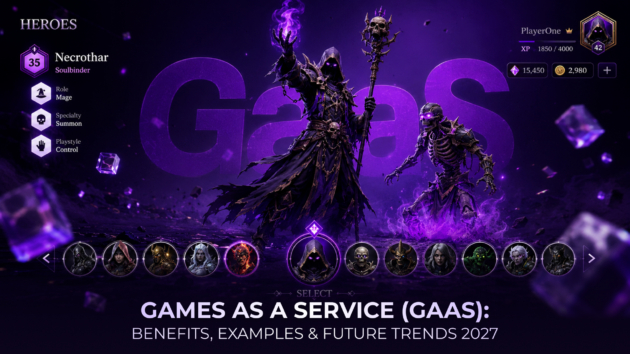

The AAA video game industry is a whole segment of the industry. It involves large budgets, long development times, and very high market expectations. It is precisely these projects that often set the standards for quality, technical directions, and business approaches. To fully understand the role of AAA games, it is necessary to delve deeper into the technical aspects in order to realistically assess the expectations for a future project.
What are AAA Games?
The term AAA constantly comes up in conversations about video games. In game development services, AAA refers to big games from big studios or publishers with large budgets and high expectations. And although AAA games are not an official category, this term best describes the level of scale. Such projects are created for a mass audience and are planned to be sold for years.

Core Characteristics of AAA Games
AAA games are easy to identify, even without looking at budget reports. Just look at the scale, level of execution, and overall AAA game production values. Such games don’t appear by accident. Behind them is a large team, clear processes, and constant quality control. That is why most such projects are created within a single triple-A studio or several teams under the leadership of a large publisher.
In a professional environment, AAA gaming is defined by recurring characteristics. It’s not just about money, but also about the approach to development. Usually, the picture looks like this:
- Large teams with clear roles. Dozens or hundreds of specialists are involved in the creation of an AAA video game. These are programmers, artists, game designers, scriptwriters, testers, producers, and marketers. Each is responsible for their part of the work.
- Very high budgets. AAA game development is expensive. The costs are often comparable to those of film production. A larger team means more coordination, more processes, and constant quality control.
- Long development period. Production usually takes several years. Time is needed to create a large game world, deep gameplay, and stable technical components.
- Active marketing before release. In the AAA segment, the AAA game marketing budget is often equal to or even exceeds development costs. Trailers, large presentations, participation in exhibitions, working with the media and content creators are part of the standard release cycle. That is why large projects are heard about long before their release. Interest builds up months, and sometimes years, before release, and the game already has an audience of millions waiting for it at launch.
- High quality standards. Smooth movements, high-quality cutscenes, detailed Game art, voice acting in different languages, no critical bugs at launch. All this is the result of long and expensive production and must meet the high expectations of players.
All these factors influence the final result. They also create significant risks for studios. The larger the scale, the greater the responsibility. Therefore, before starting such a project, it is important to realistically assess AAA game development costs, resources, deadlines, and goals. This helps to avoid unpleasant surprises in the middle of development.
AAA vs. Other Game Tiers
The best way to understand the place of AAA games in the market is to compare them with other categories. AAA vs indie games or AAA vs AA games best demonstrate the difference in budget, risk level, and the very approach to development. If you are planning to launch a game or analyzing the market, these differences become immediately apparent.
| Criteria | AAA | AA | Indie |
| Budget | Very high | Medium | Low |
| Team size | Hundreds of specialists | Dozens of specialists | Small teams |
| Publishers | Major game publishers | Mid-sized companies | Self-publishing |
| Risk level | High | Moderate | Low |
| Target audience | Mass market | Niche or broad | Niche |
Compared to other segments, triple-A games are focused on stable commercial results. Because of this, large companies rarely experiment with radical mechanics. Indie projects, on the other hand, can afford to take risks because their costs are significantly lower and market demands are not as strict.
Examples of AAA Games
When people talk about AAA game examples, they usually mean games that combine large budgets, complex technical implementation, and wide recognition among players. It is these projects that most often set the benchmarks for the market and influence how next-gen AAA games will look and work. For many companies, they serve as an example of what a modern, commercially successful release should be.
The most common AAA video game formats are familiar to most players, as they regularly appear in major releases:
- large-scale open-world action games with a lot of side content;
- story-driven role-playing games with full voice acting, cinematic scenes, and long campaigns;
- multiplayer projects with regular updates and long-term support.
Each such release is created with significant AAA game development costs and detailed planning in mind, even at the idea stage. That is why large publishers estimate how long does it take to make a video game in advance before launching production. For AAA projects, this process almost always takes several years, as mistakes in the later stages are too costly.
The Future of AAA Games
The future of AAA games is closely linked to rising costs and technological expectations. Large-scale game development is becoming even more complex thanks to the need for realistic graphics, sophisticated artificial intelligence systems, and cross-platform support. This directly affects the AAA game budget and development time.
At the same time, the AAA video game industry is looking for ways to optimize production. The role of outsourcing, specialized studios, and services that help reduce costs without compromising quality is growing. In this context, external teams are increasingly being brought in for art direction, testing, and technical support.
The coming years are expected to bring more hybrid models. AAA games will increasingly combine premium quality with elements of service games. This allows large companies to support projects for longer and spread financial risks evenly.

Conclusion
AAA games occupy a special place in the gaming industry thanks to their scale, budget, and level of expectations. When people talk about a triple-A game, they usually mean a project that has taken years of work, significant resources, and serious business stakes. Such games set technical standards and influence market development.
At the same time, AAA does not mean a universal solution for everyone. High costs, a complex production cycle, and dependence on mass success make this segment risky. That is why AAA games coexist with other formats and continue to evolve along with technology and audience expectations.
FAQ
What is an AAA game, and why is this term still relevant?
AAA is used to refer to games with large budgets, large-scale development, and support from major publishers. The term remains relevant because it helps to quickly understand the level of the project.
Do all expensive games automatically become AAA?
No. Not only do costs play an important role, but also the approach to production, marketing, and post-release support. Without this, the game is not perceived as AAA.
How does AAA differ from other formats?
The main difference is in the size of the team, budget, and market expectations. AAA games are usually aimed at a wide audience and a global release.
Who creates AAA games?
Most often, these are large studios and publishers with many years of experience, their own infrastructure, and well-established production processes.